
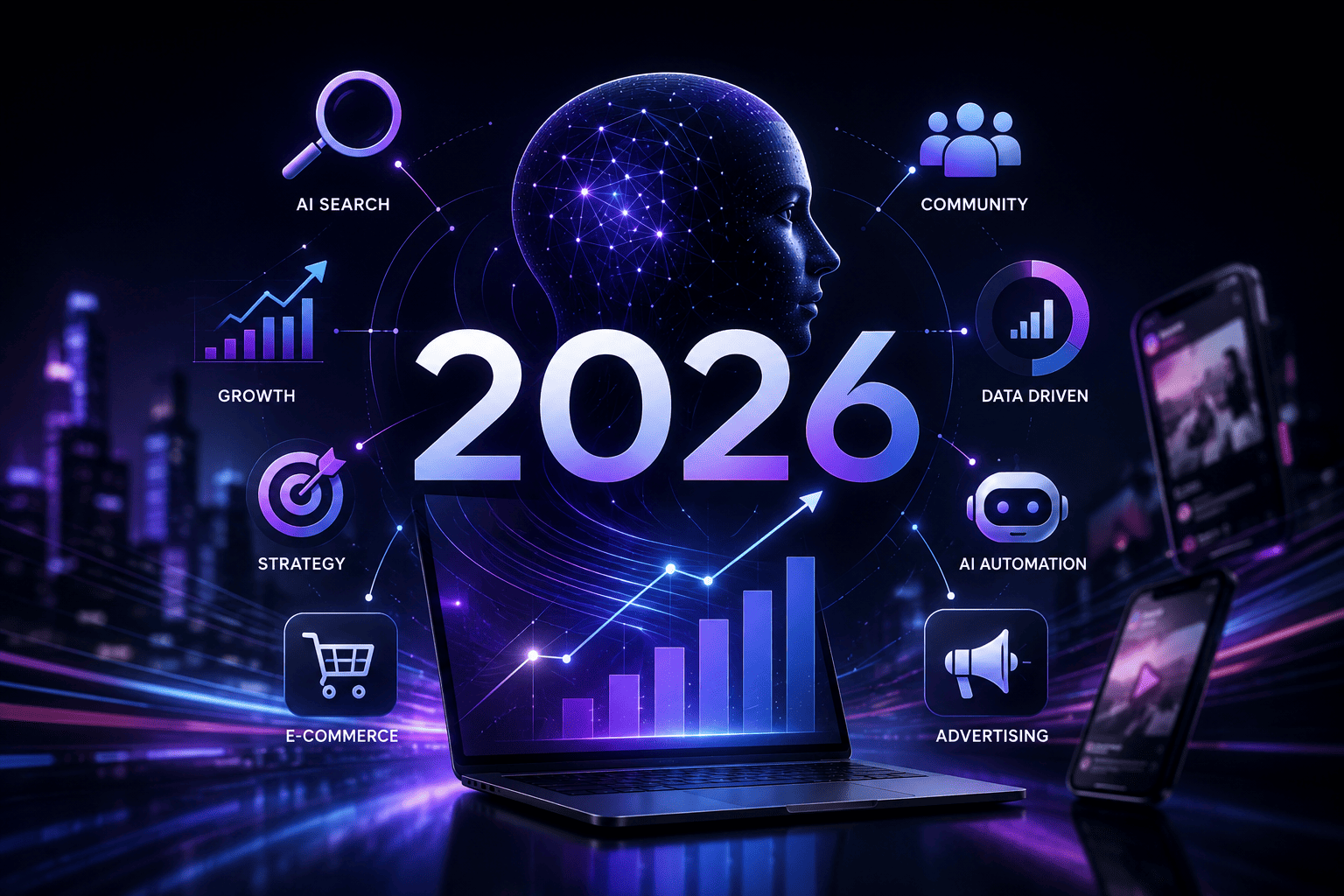
The digital marketing in 2026 It will no longer be a simple matter of having an online presence. Having a website, publishing content, or running advertising campaigns will no longer be enough.
The real difference will be building a digital ecosystem capable of working in an integrated way: website, SEO, advertising, content, data, AI, automation, and conversions will all have to communicate with each other.
In recent months, the market has accelerated in a clear direction. Google is integrating more and more AI features into search, with AI Overviews and AI Mode Designed to answer more complex and conversational queries. Google describes AI Mode as a more advanced, multimodal search experience capable of managing follow-ups and progressive insights.
At the same time, advertising platforms are becoming increasingly automated. Google, Meta, and TikTok are pushing AI-based tools to optimize targeting, creative, assets, budgets, and results. TikTok, for example, describes Smart+ as an AI system designed to automate campaigns, targeting, optimization, and creative.
This means one thing: in 2026 the competitive advantage will not be using more tools, but make them work better together.
From fragmented digital marketing to an integrated ecosystem
For years, many companies have managed digital marketing in separate compartments. The website on one side, social media on the other, Google Ads campaigns as a standalone activity, SEO as an occasional technical intervention, and CRM as a simple contact database.
This model will be less and less effective by 2026.
Users don't follow linear paths. They can discover a brand on TikTok, search for it on Google, read a review, visit the site on mobile, sign up for a newsletter, and purchase days later on desktop.
If these steps are not connected, the company loses data, trust, and business opportunities.
The first real trend of 2026 isn't a tool. It's a shift in methodology: moving from channel marketing to ecosystem marketing.
An effective digital ecosystem must attract traffic, transform it into a relationship, and lead the user to a measurable action.
1. AI Search: SEO is changing because search is changing
SEO in 2026 will be increasingly influenced by artificial intelligence.
Google has introduced and expanded features like AI Overviews and AI Mode, creating experiences where users can receive concise answers, insights, and more conversational search paths directly in the SERP. Google has also published a specific guide for site owners on how AI features in Search interact with web content.
This changes the role of content.
It's no longer enough to write articles optimized for a keyword. Pages must be designed to answer real questions, clarify concepts, demonstrate authority, and help AI systems understand the content's value.
In 2026, an effective SEO strategy will have to work on:
- more specific search intentions;
- conversational content;
- Really helpful FAQs;
- synthetic answers;
- structured data;
- brand authority;
- continuous updating of contents;
- internal links to commercial pages.
SEO isn't going away. It's becoming more selective.
Companies will have to stop producing generic content and start building pages that are useful to the user, understandable to Google, and consistent with the conversion path.
2. Zero-click and AI Overview: Less generic traffic, more real value
One of the biggest themes of 2026 will be the growth of clickless searches.
When the answer is displayed directly on the results page, some users may no longer visit the site. This doesn't mean SEO loses its value, but it does mean the way it's measured changes.
In the new landscape, it's not enough to just look at organic traffic. You also need to consider brand visibility, targeted queries, click-through rates, leads generated, conversions, and visit quality.
The most useful pages will be those that do three things:
- appear in relevant information contexts;
- build trust even before the click;
- offer a strong reason to visit the site.
For DigiFe, this means designing content not only to position itself, but to become strategic assets: guides, service pages, articles, landing pages, and resources capable of transforming attention into relationships.
3. AI marketing: from creative to operational use
By 2026, artificial intelligence will no longer be just a tool for generating text, images, or ideas for social media.
The true value of AI will be operational.
Companies will use it to analyze data, segment users, optimize campaigns, generate creative variations, personalize content, automate follow-ups, and improve the customer journey.
Meta is already pushing in this direction. According to Reuters, the company aims to increasingly automate ad creation and targeting using AI, with systems capable of generating creative variations and personalizing ads based on the user's context.
This doesn't mean leaving everything to the platforms.
In fact, the more automation increases, the more important strategy, creative control, accurate data, and asset quality become.
AI can accelerate.
But without direction it only produces faster content, not better results.
4. AI Advertising: Targeting Matters Less, Creative Signal Matters More
Advertising platforms are progressively reducing the weight of manual targeting and increasing that of algorithms.
Google Performance Max, Meta Advantage+, and TikTok Smart+ all point in the same direction: using AI and machine learning to find users, combine assets, test variations, and optimize results.
Google defines Performance Max as a campaign that uses Google channels and AI to maximize performance, with increasingly advanced controls over assets and optimization.
This changes the marketer's job.
In 2026, simply setting audiences, budgets, and interests won't be enough. Platforms will need to be given strong signals:
- different creativity;
- clear copy;
- consistent landing pages;
- clean conversion data;
- events tracked correctly;
- optimized product catalogs;
- updated feeds;
- content designed for different stages of the funnel.
Control shifts.
You no longer control everything manually within the campaign.
You control the quality of the system that powers the algorithm.
5. First-party data: proprietary data becomes indispensable
Privacy will continue to be a central topic in 2026.
Google has updated its Privacy Sandbox and third-party cookies process several times, maintaining an approach based on user choice and alternative solutions for measurement and privacy-preserving advertising.
For companies, the key isn't waiting for yet another cookie update. The key is building a proprietary data system.
THE first-party date They become a competitive advantage because they allow us to better understand users, segment communications, improve campaigns and reduce dependence on external platforms.
In 2026 they will become increasingly important:
- CRM;
- newsletter;
- smart forms;
- lead magnet;
- reserved areas;
- GA4 events;
- tracked customer journeys;
- automations;
- e-commerce data;
- proprietary audience segments.
The data must not be collected "to create a database".
It must help us communicate better, sell better, and make better decisions.
6. The website returns to the center of the digital system
In 2026, the website will be even more important.
Platforms change rules, algorithms, and costs. Social media can generate attention, but not always control. Campaigns can drive traffic, but don't guarantee conversions. The website, however, remains the proprietary space where a brand can build trust, collect data, and convert visits into leads or sales.
But having an online site is not enough.
An effective website in 2026 must be:
- fast;
- responsive;
- clear;
- SEO-oriented;
- tracked correctly;
- with smooth UX;
- conversion-oriented;
- integrated with CRM, analytics and campaigns;
- ready to support content, advertising and automation.
The site should not be a showcase.
It must be the operational center of digital marketing.
The question is no longer: “is the site beautiful?”.
The question is: “Is the site working for business?”.
7. Marketing automation: follow-up becomes strategic
Many companies miss out on opportunities not because they don't generate traffic, but because they don't manage what happens after the first contact.
By 2026, marketing automation will become a key lever for transforming visits, leads, and customers into measurable journeys.
A user filling out a form shouldn't be left standing still.
An abandoned cart should not be forgotten.
An existing customer should not receive generic communications.
Automations allow you to build different paths based on user behavior:
Phase |
Useful automation |
|---|---|
| First contact | Welcome email, in-depth content, CRM segment |
| Hot lead | Commercial follow-up, reminder, case study, invitation to consultation |
| Ecommerce | Cart recovery, cross-selling, post-purchase, review request |
| Inactive customer | Reactivation, personalized offer, dedicated content |
| Loyal customer | Loyalty, referrals, upsells, premium newsletters |
Automation doesn't have to make your brand cold.
It must make the relationship more timely, coherent and useful.
8. Video and social commerce: content must help make decisions
In 2026, video will not just be a format to get views.
It will increasingly be a tool for explaining, reassuring and selling.
For e-commerce and product brands, videos can show materials, dimensions, real-world usage, details, comparisons, and reviews. For service companies, they can explain processes, results, methods, case studies, and expertise.
The difference will be between content that entertains and content that brings the user closer to a decision.
The most effective videos will be:
- short but clear;
- integrated into the product sheets;
- reusable on social media and landing pages;
- oriented towards real questions;
- connected to CTA;
- consistent with the funnel;
- supported by tracking.
Content shouldn't just be watched.
It should move the user to the next step.
9. TikTok, creators, and discovery platforms: search isn't just on Google
In 2026, research will be increasingly distributed.
Users also search for products, reviews, advice, and solutions on TikTok, Instagram, YouTube, marketplaces, communities, and AI assistants.
TikTok itself is positioning the platform as a place where people search, discover, and interact with communities in real time, and is expanding automated and creative advertising tools for advertisers.
This means that the content strategy must move beyond the “public on the blog and that’s it” mentality.
A brand must cover multiple environments, but with a coherent message.
The same idea can become:
- SEO article;
- reel;
- short video;
- carousel;
- e-mail;
- landing;
- announcement;
- FAQ;
- content for product sheet;
- video script.
Value is not producing more.
It's about transforming strong content into multiple coherent touchpoints.
10. Community and trust: the brand must become recognizable
In a market filled with AI-powered content, automated ads, and similar messaging, trust will become one of the most important levers.
Users will choose brands that are recognizable, consistent, and credible.
This is why in 2026, communities, reviews, testimonials, user-generated content, newsletters, and customer care will play an increasingly important role.
The community doesn't have to be huge. It could be an engaged customer base, a newsletter with active users, a vertical social audience, or a professional niche that recognizes the brand's value.
The point is not to speak to everyone.
The point is to become relevant to the right people.
Trust doesn't come from a single piece of content.
It arises from consistency repeated over time.
11. Personalization: Different messages for different users
By 2026, generic communication will work less and less.
Users expect journeys that are more relevant to their behavior, interests, and stage of their journey.
A new visitor needs to understand who you are.
A warm lead needs proof and reassurance.
An existing customer may be interested in a complementary service.
A user who has abandoned their cart needs to overcome a doubt.
Personalization can be applied to:
- e-mail;
- landing page;
- offers;
- remarketing campaigns;
- chatbot;
- product recommendations;
- dynamic content;
- CRM paths;
- automations.
It doesn't mean creating complex experiences for every single person. It means using data to avoid one-size-fits-all communications.
In 2026, relevance will be a competitive lever.
12. Measurement and ROI: Less vanity metrics, more decisions
Digital marketing in 2026 will need to be more measurable.
Likes, views, impressions, and clicks are no longer enough. They may be useful signals, but they alone don't convey the value generated.
Companies will have to measure what really matters:
Area |
Main KPIs |
|---|---|
| SEO | Organic traffic, CTR, targeted queries, organic conversions |
| Advertising | CPA, ROAS, cost per lead, conversion rate, traffic quality |
| Website | Events, form submissions, scrolling, load time, conversions |
| Ecommerce | Purchases, abandoned carts, average order value, revenue |
| CRM | Qualified leads, follow-up, pipeline, closing rate |
| Email marketing | Open rate, click rate, conversions, active automations |
| Community | Real engagement, reviews, UGC, customer returns |
A dashboard doesn't have to be full of numbers.
It should help you make decisions.
In 2026, measuring well will be as important as communicating well.
Operational priorities for digital marketing 2026
Trends aren't about chasing every new thing. They're about making better choices.
For an SME, an e-commerce business, or a company looking to grow online, the priority isn't getting everything up and running at once. It's building a system with solid foundations.
Priority |
Objective |
Recommended actions |
|---|---|---|
| P0 — Digital Foundations | Make the site solid and measurable | Performance, UX, mobile, technical SEO, security, tracking |
| P1 — Traffic Acquisition | Bring in qualified users | SEO, Google Ads, social ads, content, multi-channel campaigns |
| P2 — Conversion | Convert visits into leads or sales | Landing pages, CTAs, CROs, trust signals, optimized forms |
| P3 — Data and Automation | Better manage contacts and customers | CRM, newsletter, segmentation, automation, GA4 events |
| P4 — AI and advertising automation | Increase efficiency and control | AI in processes, creative assets, feeds, automated campaigns |
| P5 — Community and Retention | Building value over time | Newsletter, reviews, customer care, referrals, loyalty |
Digital Marketing Roadmap 2026
Phase 1 — Digital Ecosystem Analysis
Before activating new channels or tools, you need to understand the real state of the system.
In this phase, the website, SEO, advertising, content, CRM, analytics, UX, funnels, automations, and conversions are analyzed.
The goal is to identify where the system loses value: low-qualified traffic, slow pages, weak landing pages, untracked campaigns, disconnected content, ineffective forms, or a lack of follow-up.
Phase 2 — Strategy and Priorities
After the analysis, a clear direction is needed.
The strategy must define audience, objectives, channels, messages, KPIs, budget, and operational priorities.
For some companies, the priority will be to redo their website.
To further optimize your campaigns.
For others, building a CRM, improving SEO, or automating follow-ups.
The strategy is to avoid random actions.
Phase 3 — Tool Integration
The next step is to connect the instruments.
Website, CRM, newsletter, advertising, analytics, e-commerce, SEO, and automation must work together.
When tools are disconnected, data becomes weak. When the system is integrated, every action becomes more readable and every decision more precise.
A lead must enter a path.
A campaign must lead to a coherent landing page.
A newsletter must speak to real segments.
An e-commerce site must track carts, purchases, and behavior.
A dashboard should show useful data, not just numbers.
Phase 4 — Continuous Production and Optimization
In 2026, the “publish and wait” approach will no longer work.
Content, campaigns, landing pages, emails, videos, automations, and funnels will need to be tested, measured, and improved over time.
Digital growth comes from continuous cycles:
analysis → action → measurement → optimization
Marketing will no longer be a sequence of isolated activities. It will be a process.
Mistakes to Avoid in 2026
The first mistake will be chasing every trend without a strategy. AI, videos, automation, and advanced campaigns are useless without direction.
The second mistake will be neglecting the website. Even with increasingly intelligent platforms, the website remains the place where traffic, content, trust, and conversions must converge.
The third mistake will be relying too heavily on advertising automation. Platforms can optimize, but they need accurate data, strong creative, and coherent landing pages.
The fourth mistake is measuring only superficial metrics. Views mean little if they don't generate leads, sales, or useful relationships.
The fifth mistake will be using AI to produce generic content. In 2026, there will be more content than ever before. Quality, not quantity, will make the difference.
FAQ on digital marketing trends 2026
What will be the main digital marketing trends in 2026?
Key trends will include AI Search, conversational SEO, automated advertising, first-party data, marketing automation, video commerce, personalization, community, and advanced measurement.
Will SEO still be important in 2026?
Yes, but it will be different. SEO will have to focus increasingly on intent, useful content, authority, AEO, structured data, and the ability to be understood by AI systems.
Will artificial intelligence replace marketing?
No. AI doesn't replace strategy, creativity, and vision. However, it can accelerate analysis, production, automation, segmentation, and optimization.
Why is proprietary data so important?
Because they allow companies to reduce their dependence on external platforms, understand their users better, personalize communications, and better measure conversions.
Where should an SME start?
An SME should start from the ground up: a high-performance website, clear UX, technical SEO, proper tracking, useful content, CRM, and an acquisition strategy consistent with business objectives.
What is the role of the website in 2026?
The website remains the center of the digital ecosystem. It's the proprietary space where traffic, content, trust, data, and conversions converge. Therefore, it must be designed as a business asset, not just a simple showcase.
Conclusion
THE digital marketing trends 2026 They point to a clear direction: digital will be increasingly integrated, automated, intelligent, and conversion-oriented.
Just being present online won't be enough.
It won't be enough to publish content.
It won't be enough to run campaigns.
Companies will need to build ecosystems that unite websites, SEO, advertising, AI, data, automation, content, and measurement.
The competitive advantage will not be using more tools than others.
It will make them work better together.
In 2026, digital marketing will reward those who can transform attention into relationships, relationships into trust, and trust into conversions.
Want to transform your digital marketing into a system that generates results?
DigiFe helps you build an integrated ecosystem made up of website, ecommerce, SEO, advertising, AI, data and automation.
It's not enough to be seen. You need to convert.