
Many companies think that the problem is having few contacts.
In reality, the real limit is often another: The contacts are there, the negotiations are taking place, the quotes are being sent, but the sales funnel is not able to transform enough opportunities into customers.
This means something very concrete.
Marketing generates leads.
The salesman makes calls.
The estimates are starting.
Negotiations appear to be open.
But then something gets stuck.
The customer does not respond.
Follow-up is not done.
The negotiation remains at a standstill.
The estimate is forgotten.
The salesperson does not update the status.
Management doesn't understand where value is lost.
The problem isn't always the product.
And it's not always the seller's ability.
The problem is often that the sales pipeline is not managed as a process, but as a sum of scattered deals.
It's not enough to have open opportunities.
We need a method to move them forward.
This is why today a CRM should not be seen just as a customer archive.
It must become the tool that makes the sales funnel visible, measures bottlenecks, guides follow-ups and helps the team better convert existing opportunities.
When the team works hard, but the turnover doesn't grow enough
In the commercial department, movement is everything.
New contacts coming in.
Negotiations are progressing.
Estimates are starting.
Customers asking for information.
Offers that come to negotiation.
On the surface, everything seems to be working.
The team is busy.
There are many activities.
Salespeople are always on call.
Quotes are being sent.
Yet, at the end of the month, the turnover does not reflect the effort.
This is one of the most dangerous signals for an SME.
Because the company feels it is doing well, but can't figure out why it isn't getting results.
The difference between activity and result is right here.
A team can be very busy and ineffective.
It can generate many quotes and close few deals.
It can open too many negotiations and leave too many unfinished.
It can chase new leads while missing out on already hot opportunities.
Second Outreach, A healthy pipeline is measured not only by the number of opportunities present, but also by metrics such as pipeline coverage, velocity of progress, probability of closing, and quality of deals.
This confirms a central point.
Turnover doesn't come from movement.
It arises from a commercial process that brings negotiations to a close.
The problem: the pipeline becomes a black box
In many companies the sales pipeline is not very visible.
Management knows how many leads have arrived.
Knows how many quotes have been sent.
He knows how much turnover has been closed.
But he doesn't see clearly what happens in between.
And the medium is the most important part.
Where contacts qualify.
Where needs are understood.
Where to send the offer.
Where objections arise.
Where follow-ups are done.
Where the customer decides whether to trust or disappear.
When this phase is not tracked, the company works in the dark.
The sales manager asks for updates.
The seller replies “I’m working on it.”.
The customer remains stationary.
The estimate remains pending.
The negotiation is not progressing.
Without clear data, it becomes difficult to understand if the problem is:
- the quality of the leads;
- the response time;
- the estimate;
- the price;
- the follow-up;
- the negotiation;
- the value proposition;
- the assigned salesperson;
- the customer segment;
- the customer's lack of urgency.
If you don't know where the pipeline is stuck, you can't unblock it.
Signs that your sales pipeline is blocked
A blocked pipeline isn't just recognizable by low turnover.
There are much more precise signals.
1. Too many negotiations stuck in the same phase
If many opportunities remain in the same column for weeks, the funnel is signaling a blockage.
It could be the preventive phase.
It could be negotiation.
It could be the first contact.
It could be the qualification.
The point is that a negotiation that stalls for too long loses commercial energy.
The customer gets cold.
The urgency decreases.
Competition comes into play.
The commercial moves on to something else.
The estimate is getting old.
A healthy pipeline must show movement.
Not just volume.
A stalled negotiation is not a lively negotiation.
It's an opportunity that's losing its temperature.
2. Follow-ups depend on the salespeople's memory
Many sales are lost not because the customer says no.
They get lost because no one calls them back at the right time.
The sales representative sends the quote.
Then other emergencies arrive.
Other leads.
More calls.
Other customers.
The follow-up remains in the memory.
But memory is not a commercial system.
If each salesperson handles follow-ups their own way, the company has no control over the opportunities.
Some leads are followed up well.
Others are forgotten.
Others receive answers too late.
Others are never reported in the CRM or sales file.
The result is a pipeline full of apparent opportunities, but poor in real action.
A quote without follow-up is a sale left unfulfilled.
3. Management doesn't know which opportunities will actually close
Another sign is the lack of foresight.
Management sees many open negotiations, but doesn't know which ones are realistic.
Some look promising.
Others have been stuck for weeks.
Others depend on external decisions.
Others have already been lost, but still remain in the pipeline.
This generates unreliable forecasts.
The sales team is optimistic.
Management plans on the expected numbers.
Then the closures don't come.
Forecastio, in its 2026 Guide to Pipeline Management, highlights that pipeline management serves to answer essential questions: what deals exist, where they are in the sales cycle, what risks they pose, and how likely they are to close.
Without these answers, the pipeline is not a control tool.
It's a list of hopes.
A useful pipeline doesn't just show what's open.
Show what is realistic to expect.
4. The reasons for the loss are not analyzed
When a deal goes awry, it's often quickly shelved.
“Price too high.”.
“Customer not interested.”.
“He chose a competitor.”.
“It wasn't the time.”.
But if this information is not recorded in a structured way, the company misses a learning opportunity.
Every lost negotiation can explain something.
A positioning problem.
A price not perceived as consistent.
An unclear proposal.
An off-target lead.
A phase of the process that is too slow.
A recurring objection.
A faster competitor.
If the reasons for losses are not tracked, mistakes repeat themselves.
And the funnel continues to lose value at the same points.
A sale lost without analysis is wasted data.
5. Salespeople work on the wrong opportunities
Not all negotiations have the same value.
Some are warmer.
Some have better margins.
Some have faster decision-making times.
Some are more likely to close.
Some, however, take up a lot of time and generate little return.
Without CRM, prioritization, and data, sales can focus on the loudest opportunities, not the most strategic ones.
Who calls the most.
Who asks for more changes.
Who seems more urgent.
Whoever takes up the most time.
But these aren't always the best negotiations.
An optimized pipeline helps the team understand where to invest energy.
Because business time is a limited resource.
And it should be used where it can generate the most value.
The consequence: the funnel silently loses customers
A blocked pipeline does not always cause an obvious problem.
It often loses value silently.
An uncalled lead.
A firm estimate.
A negotiation without activity.
A negotiation that was not followed up.
A customer who disappears.
A salesperson who doesn't update the status.
A manager who discovers the problem too late.
Each loss seems unique.
But when added together they create a huge impact.
Fewer conversions.
Longer sales cycle.
Forecast less reliable.
Less effective marketing budget.
Salespeople under more pressure.
Margins more difficult to control.
More unstable turnover.
The point is simple.
It's not always about generating more leads.
Often you need to better convert the ones you already have.
And this is where the pipeline becomes a strategic tool.
Not just to “follow sales”.
But to understand where the company is missing opportunities.
The new vision: selling is not just talent, it's process
Commercial talent matters.
Relationships matter.
Experience counts.
But they are not enough.
As the company grows, selling must become a measurable process.
This does not mean taking away freedom from commercials.
It means giving them a structure that helps them work better.
A well-designed pipeline allows you to understand:
- where every opportunity lies;
- what is the next step;
- who is responsible;
- how long has the negotiation been at a standstill;
- what activities have been done;
- what objections have emerged;
- how much is the deal worth;
- what is the probability of closure;
- which forecast is realistic;
- what actions are needed to move forward.
Selling doesn't have to be a black box.
It must become a visible path.
CRM does not replace the salesperson.
It gives him method, priority and control.
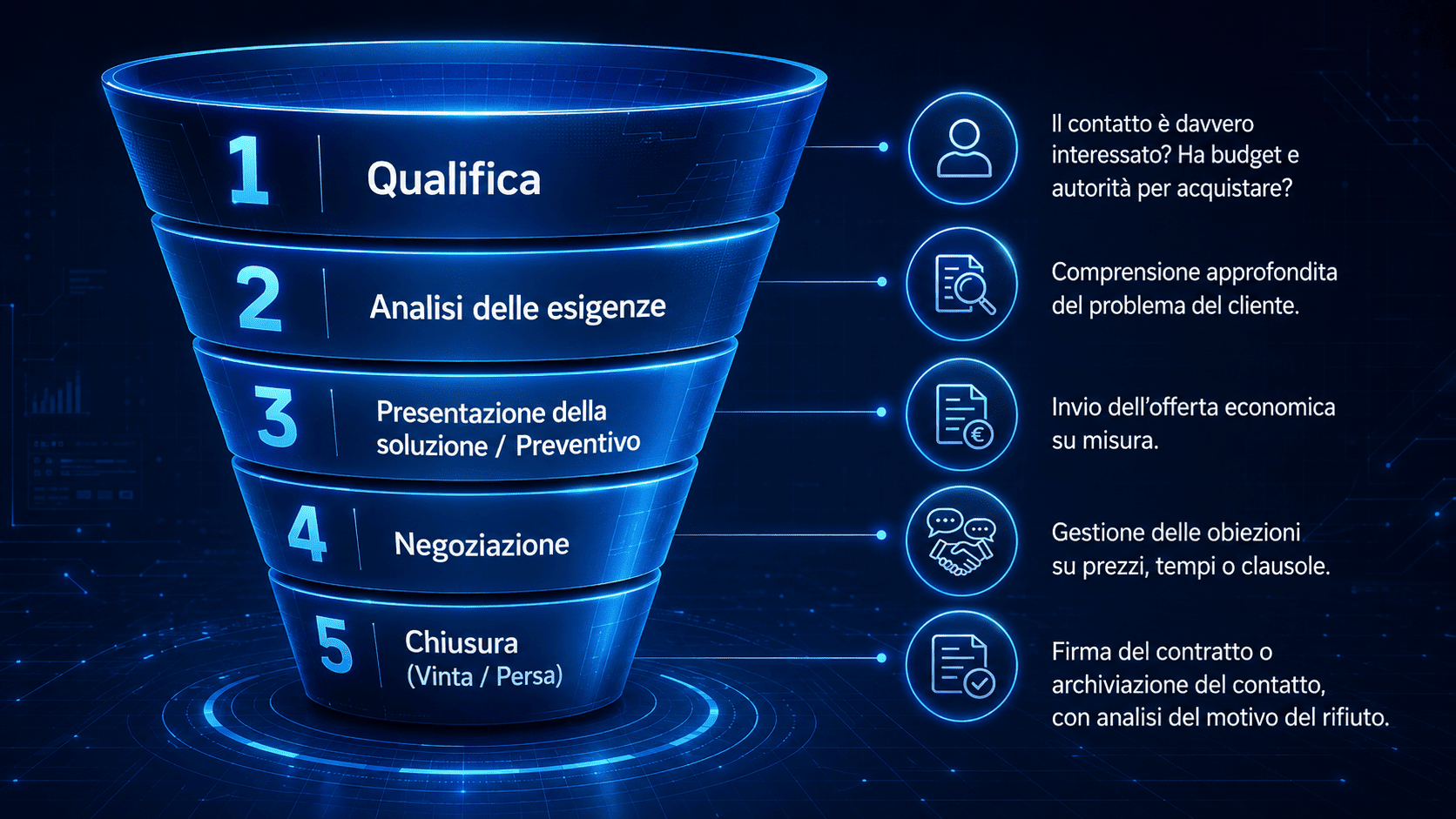
Map the stages of the sales funnel
To optimize the pipeline you must first define the phases.
Each company may have a different process.
But an effective sales funnel should have clear steps.
1. New lead
The contact enters the system.
It can come from a website, ads, referrals, trade shows, emails, calls, social media, or direct marketing.
At this stage we need to understand where it comes from and what request it has expressed.
2. Qualification
The lead is evaluated.
Is it on target?
Do you have a real need?
Do you have a budget?
Is it urgent?
Does he have decision-making power?
Is this the right time?
This phase prevents the team from working on less useful contacts.
3. Needs analysis
The salesman delves into the problem.
Understands goals, constraints, expectations, priorities, and context.
An effective proposal comes from a good diagnosis.
4. Estimate or proposal
The offer is sent.
Here it is important to track the date, value, margin, products or services included, responsible salesperson and next follow-up.
5. Negotiation
The customer evaluates, asks for clarification, compares alternatives or discusses conditions.
This stage requires attention.
Because many negotiations get stuck right here.
6. Win or Lose Closure
The deal is concluded.
If it is won, the operational transition must begin.
If it is lost, the reason must be recorded.
This data is used to improve the process.
A pipeline only works if each stage has clear entry, exit, and progress criteria.
CRM as a visual pipeline
CRM transforms the funnel into a visual pipeline.
Every negotiation becomes a card.
Each card has a status.
Each state indicates a stage in the process.
The team can immediately see:
- what negotiations are open;
- where they are located;
- how much are they worth;
- who follows them;
- how long have they been stopped;
- what activities are planned;
- which follow-ups are overdue;
- which opportunities are most important;
- which deals are at risk of being lost.
This changes the way we work.
Sales are no longer managed via memory, Excel files, or voice updates.
We work on a shared basis.
Pipedrive, in the 2026 guide to sales and marketing automation, highlights the value of automating lead assignment, sales activities, follow-up, and ROI tracking within a CRM.
That's exactly the point.
An effective CRM isn’t just about “seeing” the pipeline.
It helps to move it forward.
The pipeline does not have to be a static list.
It must be a system that guides commercial action.
CRM Automations to Unlock the Funnel
A well-built pipeline becomes even more effective when supported by automations.
Automations reduce forgetfulness, delays, and manual tasks.
Follow-up reminders
If a quote has been sitting idle for too many days, the CRM can create an automatic task.
The salesperson receives a notification.
The manager can see the negotiations without movement.
This prevents deals from going cold.
Alert on stalled negotiations
A deal that has been under negotiation for too long can generate an alert.
Not to check the seller.
But to understand if support is needed.
A call.
A new proposal.
A clarification.
An intervention from the manager.
Automatic lead assignment
Leads can be assigned based on geographic location, service requested, industry, potential value, or salesperson availability.
This reduces response times and dispersion.
Automatic status update
Some actions can update the status of the deal.
For example:
- completed form;
- quote sent;
- open email;
- call completed;
- signed contract;
- payment received.
The system becomes more up-to-date and less dependent on manual entry.
Transition from sales to operations
When a deal is won, the CRM can automatically generate tasks for administration, operations, or project managers.
The sale does not remain isolated.
It becomes a process.
Every useful automation eliminates a point where the pipeline could get stuck.
KPIs to monitor to understand if the pipeline is working
To optimize your sales funnel, it's not enough to look at how many deals are open.
You need to measure the right KPIs.
| KPIs | What does it measure? | Why it matters |
|---|---|---|
| Number of open opportunities | How many deals are in the pipeline? | Measure trade volume |
| Pipeline value | Total value of open deals | Show future potential |
| Pipeline coverage | Pipeline to Target Relationship | It helps to understand if the target is realistic |
| Win rate | Percentage of negotiations won | Measure commercial effectiveness |
| Sales velocity | Speed at which opportunities generate revenue | It helps you understand how quickly you sell |
| Deal aging | How long a deal remains in a phase | Highlights stalled negotiations |
| Conversion by phase | Percentage of transition from one phase to another | Shows where opportunities are being missed |
| Average closing time | Average sales cycle length | Indicates the speed of the process |
| Reasons for loss | Causes of missed sales | Turn failures into useful data |
| Weighted Forecast | Expected revenue based on probabilities | Helps predict realistic outcomes |
Outreach, in its 2026 guide to pipeline management best practices, indicates pipeline coverage as one of the key inputs for understanding whether revenue objectives are structurally achievable before the close of the sales period.
This demonstrates how important it is to read the pipeline not just as a list of deals, but as a forecasting system.
What you don't measure in the funnel, you only discover when it's too late.
Sales forecasting: from pipeline to forecast
A well-managed pipeline isn't just for salespeople.
It also serves the management.
Because it allows you to build more realistic sales forecasts.
If each deal has a value, stage, and probability of closing, CRM can help estimate expected revenue.
For example:
- early stage opportunity: low probability;
- quotes sent: medium probability;
- advanced negotiations: higher probability;
- contracts awaiting approval: very high probability.
This allows you to create weighted forecasts.
Not based on optimism.
But on data, history and real progress of the pipeline.
Salesforce, in the 2026 guide to B2B sales tools, highlights how modern CRM platforms support pipeline visibility, forecasting, automation, and AI-driven selling.
The value is clear.
Management no longer needs to just ask, “How much have we sold?”.
You must be able to ask:
“How realistic is it to sell in the next few months?”
A clear pipeline isn't just for selling today.
It helps to better predict the company's commercial future.
How to Optimize Your Sales Funnel with a CRM
Optimizing your pipeline isn't just about installing a CRM.
It means designing the business process.
1. Analyze the current funnel
First we need to understand how negotiations are managed today.
Where do leads come from?
Who qualifies them?
How is the quote sent?
Who does follow-up?
Where are opportunities blocked?
What data is updated?
Which negotiations are still at a standstill?
What reasons for loss are recorded?
This analysis shows where the funnel loses value.
2. Define clear phases
Each phase must have a precise meaning.
It's not enough to create generic columns.
It is important to establish when a negotiation enters a phase and when it can exit it.
For example, a negotiation should not be moved to “negotiation” just because the customer has responded.
There should be a real discussion about terms, price, timing, or decision.
3. Assign responsibilities
Every opportunity must have a contact person.
Every activity must have a deadline.
Every follow-up must be tracked.
If a negotiation doesn't have a next step, it's already at risk.
4. Connect marketing and sales
The pipeline works best when the CRM also collects the lead source.
This allows you to understand which campaigns, channels or contents generate the best opportunities.
Not just more contacts.
But contacts that advance through the funnel and become customers.
5. Automate follow-ups and alerts
The CRM should help the team not to forget important tasks.
Reminders, notifications, and alerts help keep the pipeline alive.
6. Monitor business KPIs
The pipeline must be read continuously.
Not once a month, when it's too late.
You need up-to-date dashboards on deals, conversions, blocks, forecasts, and loss drivers.
7. Conduct periodic pipeline reviews
The pipeline must be cleaned.
Dead negotiations should not remain open for months.
Stalled deals need to be analyzed.
Real opportunities need to be given attention.
A periodic review helps the team work on priorities.
Mistakes to avoid in pipeline management
Keeping too many negotiations "open" without checking whether they are alive
A bloated pipeline gives a false sense of security.
Better to have fewer opportunities, but real, up-to-date and qualified ones.
Not defining clear criteria for the phases
If each salesperson interprets the phases in their own way, the forecast becomes unreliable.
Don't do structured follow-ups
Follow-up cannot depend on memory.
It must be planned, tracked and measured.
Do not record the reasons for loss
Without reasons for loss, the company does not learn.
And he keeps repeating the same mistakes.
Measure only the number of quotes sent
Sending quotes doesn't mean generating sales.
We need to measure how many quotes are in progress, how many are closed, and why.
Use CRM as an archive, not as an operational tool
If the CRM is only updated after the fact, it loses value.
Must lead the day-to-day activities of the sales team.
Checklist: Is your pipeline really under control?
| Request | What does it indicate? |
|---|---|
| Does every negotiation have a specific phase? | The funnel is mapped |
| Does every opportunity have a next step? | The sale is driven by actions |
| Do you know how long a deal has been stuck? | Blocks are visible |
| Are follow-ups scheduled? | Negotiations do not depend on memory |
| Do you know the win rate per phase? | You know where the funnel converts or loses |
| Do you record the reasons for loss? | Failures breed learning |
| Do you know which channels lead to better negotiations? | Marketing and sales are connected |
| Do you have a weighted forecast? | Management can predict better |
| Are dead deals being cleaned from the pipeline? | The data remains reliable |
| Does CRM help your team every day? | The tool is operational, not just administrative |
If many responses are negative, the pipeline is not just blocked.
It's hard to read.
And a poorly readable pipeline cannot be optimized.
Sales Pipeline and CRM FAQs
What is a sales pipeline?
The sales pipeline is the representation of sales negotiations at various stages of the process, from the first contact to the successful or unsuccessful closing.
What is the difference between a pipeline and a sales funnel?
The funnel describes the overall journey from contact to conversion. The pipeline shows active sales opportunities and their progress through the various stages of the sale.
Why does a pipeline get stuck?
A pipeline stalls when there's a lack of follow-up, clear steps, updated data, priorities, responsibilities, or follow-up actions. Often, the problem isn't the number of leads, but the management of the deals.
How can a CRM help?
A CRM makes opportunities visible, organizes stages, assigns responsibilities, automates follow-ups, measures KPIs, and helps identify bottlenecks in the sales funnel.
What KPIs should you measure in your pipeline?
The main KPIs are pipeline value, win rate, sales velocity, deal aging, conversion by stage, average time to close, loss reasons, and weighted forecast.
What is a weighted forecast?
It is a sales forecast based on the value of open deals multiplied by the probability of closing associated with the stage they are in.
Do you need more marketing if your pipeline is blocked?
Not always. Before increasing your marketing budget, you need to determine whether the leads already generated are being properly followed up, qualified, and converted.
Conclusion
A blocked pipeline isn't just a business problem.
It's a sign that the sales process isn't visible, measurable, and guided enough.
The team can work hard.
Marketing can generate leads.
Estimates can start.
But if negotiations don't progress, the value is lost.
To grow, it's not enough to fill the funnel.
You need to make it work.
It's important to understand where opportunities stop, which follow-ups are missing, which phases generate friction, which negotiations are truly live, and what data management needs to make better decisions.
Having a full pipeline is not enough.
You need a pipeline that converts.
Want to understand where your sales funnel is stuck?
DigiFe Analyze your sales process, map pipeline stages, identify bottlenecks, and set up a customized CRM to help your sales team manage follow-ups, negotiations, forecasts, and conversions more clearly and measurably.
Optimize your sales network with DigiFe consulting.