
Creating a B2B E-commerce Integrated with Management Software: The Digital Turning Point for Manufacturing and Distribution Companies
In the Business-to-Business (B2B) sector, the traditional sales process based on paper catalogs, endless email exchanges, telephone orders, and manual entry by in-house operators has become an unsustainable bottleneck. Manufacturers, distributors, and wholesalers face a market that requires the same fluidity, speed, and transparency typical of the consumer (B2C) world. Corporate customers, accustomed to purchasing on Amazon privately, expect the same autonomy when purchasing stock of components, raw materials, or goods for their own businesses.
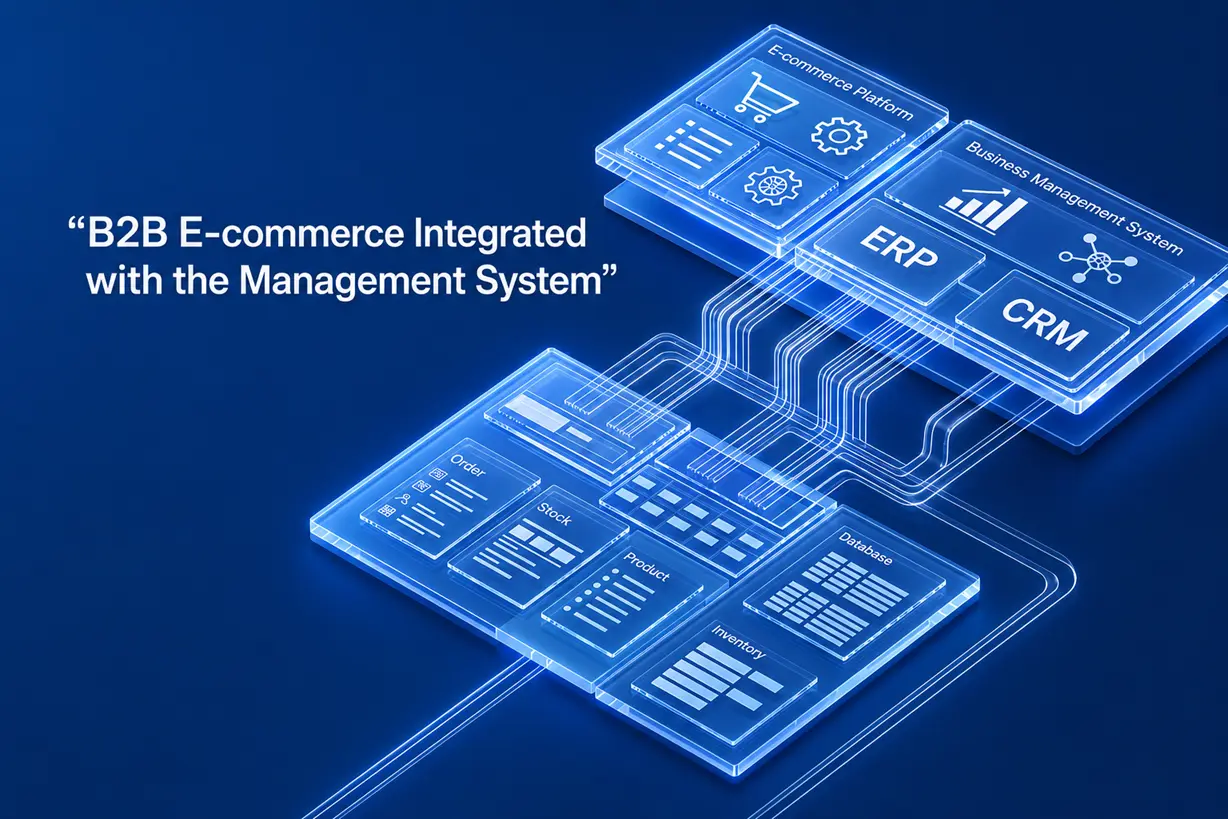
The answer to this need is the creation of a B2B e-commerce integrated with the company management system (ERP). It's not just about putting a product showcase online, but about creating a true self-service portal that communicates in real time with the company's operational, logistical, and financial heart.
The peculiarities of B2B e-commerce compared to B2C
To understand the importance of B2B e-commerce integrated with ERP, it's necessary to analyze how B2B sales dynamics are profoundly different and more complex than those aimed at the end consumer. In B2C, the price of a product is the same for all logged-in users, inventory is visible globally, and payment is made at the time of ordering via credit card or PayPal. In B2B, the scenario changes radically.
Customized price lists and tiered discounts
Every corporate customer is unique. A long-standing distributor purchasing large volumes will have access to a different price list than a new, one-time customer. An efficient B2B e-commerce site must be able to recognize users upon login and instantly display their specific commercial terms, existing contracts, tiered discounts (e.g., 5% discount for 100 items, 10% for 500 items), and dedicated promotions.
Flexible payment methods and corporate credit lines
In the professional world, immediate payment is the exception, not the rule. Transactions often occur via bank receipt (Ri.Ba.) with a 30-, 60-, or 90-day deadline, or via post-dated bank transfer. The online sales platform must integrate with the ERP's financial data to verify the customer's remaining credit limit in real time: if the company has exceeded its credit limit or has outstanding invoices, the system must block the order or request immediate payment.
The Central Role of ERP Integration: Eliminating Data Silos
The true potential of an integrated B2B e-commerce is unlocked when the web platform (developed on professional systems such as Magento/Adobe Commerce, advanced WooCommerce or custom solutions) is connected bidirectionally via API (Application Programming Interface) to the company management software (such as SAP, Microsoft Dynamics, Oracle, or the popular Italian management software such as Zucchetti, Teamsystem, Passepartout).
Without this integration, the website becomes a detached island that requires massive human effort to keep up to date, negating the benefits of automation.
Warehouse inventory synchronization
Selling an out-of-stock product online is a serious mistake in B2C, but it can be catastrophic in B2B, where a customer could stall an entire production line due to a delay. ERP integration ensures that whenever an item is sold through traditional channels (agents, telephone) or downloaded for production, the availability on the e-commerce portal is instantly updated, showing actual availability or expected replenishment times.
Order flow automation
When a customer places an order on the B2B portal, the data doesn't need to be emailed to the sales office for manual retyping. The integration enters the order directly into the ERP, automatically generating the warehouse commitment, the logistics delivery note, and the pre-invoice. This eliminates human transcription errors and reduces order fulfillment times from days to a few hours.
Strategic advantages for the sales network and customer care
A common fear among manufacturing companies is that introducing an integrated B2B e-commerce portal could cannibalize or disrupt their network of local agents and representatives. Reality proves the exact opposite: e-commerce becomes the sales force's best ally.
Free up time for high-value consulting
Much of sales agents' time today is wasted doing data entry or answering phone calls from customers who simply ask: “How much does this piece cost me?” or “Is the item available in stock?”. By moving these routine operations to the online portal, customers can place orders independently 24/7, even on holidays. The agent thus becomes a strategic consultant, focused on developing new customers and selling high-margin solutions.
Dedicated access for agents (Agent Portal)
The best B2B platforms integrate an "agent login" feature. The salesperson, on the customer's site, can access the e-commerce site with their credentials, select the customer profile they're visiting, view their prices, check their order history, and upload the order directly from their tablet during the meeting, confident that the terms and conditions are perfectly aligned with headquarters' guidelines.
DigiFe's roadmap for developing a successful B2B project
Creating an integrated B2B e-commerce site is a structured project that requires multidisciplinary skills: web development, cybersecurity, UX design, and a deep understanding of corporate database logic. DigiFe follows a rigorous process divided into four macro-phases:
-
Process and Data Structure Analysis: Mapping how the company currently manages customers, price lists, and product variants within its management system.
-
API Architecture Design: Definition of communication protocols between e-commerce and ERP to ensure secure, encrypted, and fast data exchanges without overloading company servers.
-
User Interface Development (UX/UI B2B): Creation of an interface focused on speed of purchase (e.g. quick entry forms via SKU code, bulk order upload from Excel/CSV files).
-
Testing Phase and Progressive Rollout: Extensive testing of financial and logistics data synchronization, followed by a pilot launch with a small group of existing customers before launching globally.
Digitizing B2B sales isn't just about keeping up with the times; it's about equipping your company with a scalable structure capable of reducing operating costs, expanding your business's geographic reach, and offering your business partners the standard of service that today's market demands.
Ready to eliminate order entry errors and scale your B2B?
Automate your price lists, synchronize your inventory in real time, and free your sales network from repetitive tasks. DigiFe develops and integrates e-commerce platforms with leading ERPs on the market.