
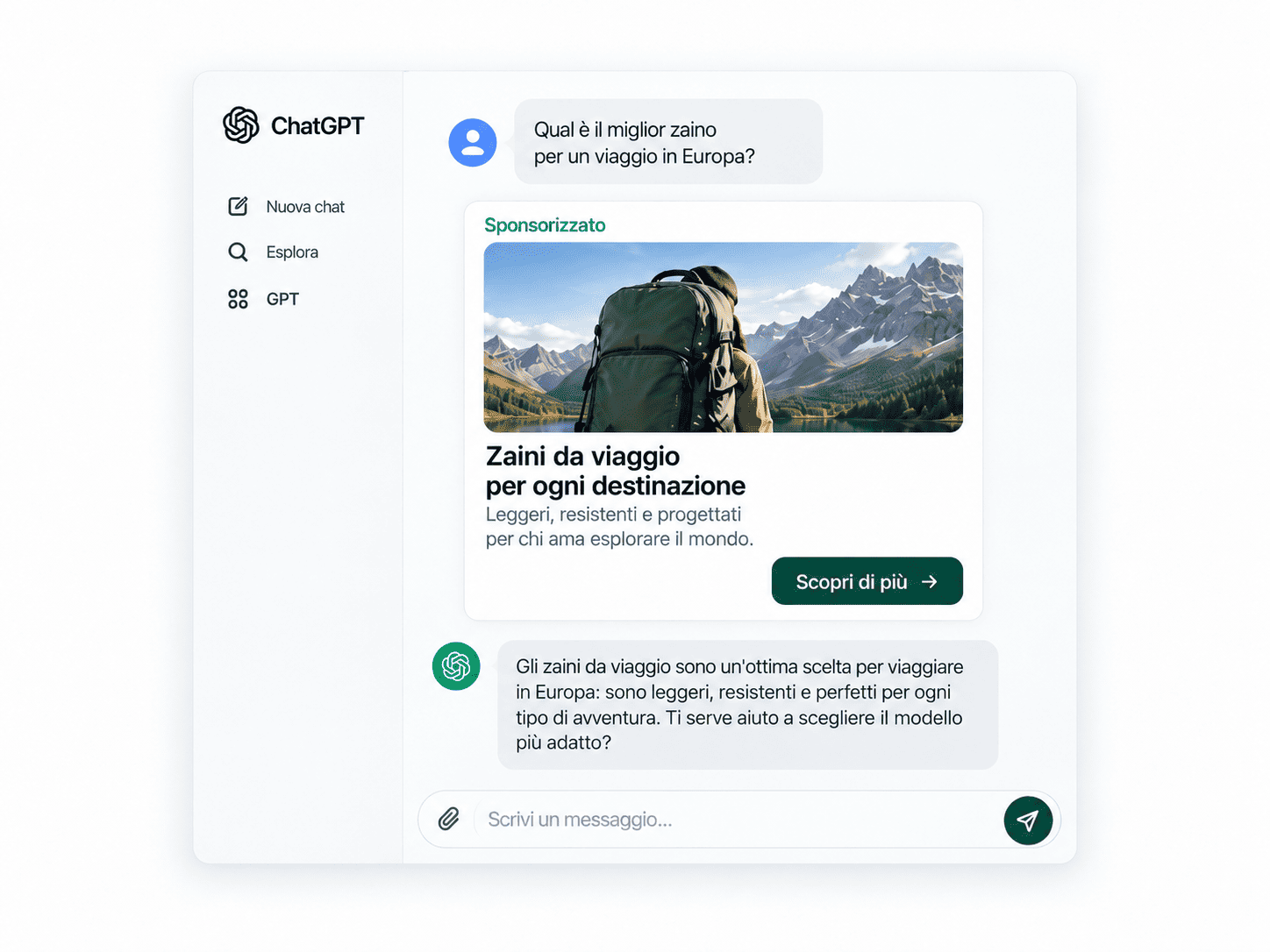
ChatGPT Ads evolves: Sponsored Agents arrive and ads become conversations
Digital advertising is entering a new phase.
On September 16, 2026, OpenAI announced a series of important new features for ChatGPT Ads, introducing a format that could profoundly change the relationship between users, ads and companies: the Sponsored Agents.
The concept is simple, but the change is significant.
Until now, online advertising has mostly followed a linear path: the user sees an ad, clicks, and is directed to a landing page, e-commerce site, or website.
With Sponsored Agents, however, the advert can become the beginning of a direct conversation with the brand.
OpenAI is testing the ability for users to open a chat with an AI agent sponsored by the advertiser after clicking on an ad on ChatGPT. This innovation was officially presented by OpenAI in the announcement dedicated to the new evolution of the’AI-based advertising.
From announcement to conversation
Imagine a user asking ChatGPT which backpack to choose for a trip.
Relevant sponsored content might appear next to the answer. But instead of just clicking the classic "Learn more" button, the user might decide to start a conversation with the brand's representative.
At that point he might ask:
- which model is best suited to your trip;
- what are the differences between two products;
- which size to choose;
- whether the product is compatible with certain needs;
- which solution best suits your specific case.
The advert therefore becomes not just an entry point to a site, but a real tool to assist in the decision-making process.
The traditional route:
Ad → click → site → conversion
could gradually transform into:
Ad → conversation → insight → conversion
And this is probably the most interesting aspect of the novelty.
Why Sponsored Agents Can Change Digital Advertising
Digital advertising has always been based on the ability to intercept a user at the right moment.
Google has built much of its model on search, Meta on understanding interests and behaviors, while social platforms have focused primarily on discovery and attention.
ChatGPT introduces a different context: the conversation.
When a user interacts with an AI assistant, they're often not simply seeking information. They're comparing alternatives, delving deeper into a problem, or seeking guidance in making a decision.
For this reason, advertising inserted in a conversational environment can take on a different function than a classic banner or display ad.
According to OpenAI's official documentation, ads in ChatGPT are designed to reach users while explore, compare and make decisions within a single conversational experience.
ChatGPT Ads is already available in Italy
The Sponsored Agents innovation is still in the testing phase, but ChatGPT Ads is no longer just an experimental US project.
In August 2026, OpenAI announced the expansion of its advertising platform to 31 European markets, including Italy. From August 31st, self-service access is also available via Ads Manager, allowing companies to create and manage campaigns directly from the platform.
Italy is therefore officially among the countries where it is possible to start using ChatGPT Ads in Europe.
For Italian advertisers, this means that ChatGPT is concretely becoming a new channel to consider within their advertising strategies.
Ads appear separately from ChatGPT responses and include elements such as the advertiser name, headline, description, image and landing page, as indicated in the official advertising format specifications.
Advertising based on intent, not just keywords
One of the most interesting aspects of ChatGPT Ads is how ads are evaluated.
OpenAI specifies that the system considers several relevance signals, including context and intent of the conversation, the ad's landing page, headline, text, any contextual cues provided by the advertiser, and targeting selections.
When ad personalization is enabled, some signals from the broader user experience on ChatGPT may also be taken into account. OpenAI describes these criteria in detail in its dedicated documentation. selection and personalization of ads.
This means that advertisers' work could gradually shift from:
“Which keyword do I want to appear on?” to: “At what point and for what need can my product become relevant?”
A seemingly subtle difference, but fundamental from a strategic point of view.
Even campaign creation becomes conversational
OpenAI is also working on the other side of advertising: the advertiser's side.
In addition to Sponsored Agents, the company announced new AI-powered tools to simplify campaign creation and management.
The goal is to enable companies to use natural language to develop their ads, starting, for example, from a brief or a website.
New features include AI tools for generating and optimizing:
- headline;
- advertising texts;
- Images;
- creative variations;
- content adaptations;
- translations.
OpenAI also announced new integrations with HubSpot, as the first CRM partner, and Shopify, as the first e-commerce partner, within the new evolution of ChatGPT Ads.
The signal is quite clear: ChatGPT Ads aims to insert itself directly into the tools already used daily by companies.
What changes for e-commerce and companies
If this model becomes widespread, campaign design will also have to change.
To date, many digital projects have been built around three main elements:
Creativity → landing page → conversion
With the introduction of AI agents, a fourth dimension comes into play:
the brand's ability to respond.
For an agent to provide useful answers, the company will need to have structured and up-to-date information on products, services, features, availability, FAQs, commercial terms, and content.
As a result, seemingly separate activities begin to converge:
Advertising, SEO, content marketing, e-commerce, CRM, and artificial intelligence.
A well-organized product catalog or a website full of clear information will be useful not only to users and search engines, but increasingly also to AI agents.
What about privacy?
The introduction of advertising into a conversational assistant makes the issue of privacy inevitable.
OpenAI states that Ads do not affect ChatGPT responses and that advertising systems are separate from the conversational model.
Advertisers cannot therefore directly influence the responses generated by the assistant.
OpenAI also clarifies that, at this stage, advertisers are primarily provided with aggregate data, such as impressions and clicks, and that the information used to make ads relevant remains within ChatGPT. These principles are explained in Official FAQ on Ads and Privacy.
However, the topic becomes particularly interesting with Sponsored Agents, because the user voluntarily decides to enter into a specific conversation with a brand.
It is therefore likely that transparency, quality of responses, and management of the data shared during these interactions will become increasingly central elements in the design of future AI-based advertising experiences.
From Search Marketing to Conversation Marketing
This evolution opens up a particularly interesting scenario.
Over the past twenty years, digital marketing has built much of its strategies around search engines, social networks, and e-commerce platforms.
Artificial intelligence is ushering in a new environment: conversation as a search and purchase interface.
This doesn’t mean Google Ads, Meta Ads, or traditional landing pages will disappear.
However, this means that a new moment could be added to the customer journey: one in which a user interacts directly with an AI system to understand what to buy, which service to choose, or which solution is best suited to their needs.
And it is precisely at that moment that brands will increasingly seek to be present.
The significance of the innovation was also highlighted by Reuters, which reported the launch of sponsored agent testing and the expansion of OpenAI’s advertising tools.
Digife's point of view
For companies, Sponsored Agents represent more than just a new advertising format.
They are the sign of a broader transformation: Online search is becoming increasingly conversational.
In this scenario, simply “being present” on a platform will not be enough.
It will become increasingly important to build digital ecosystems in which website, e-commerce, CRM, catalogs and contents are updated, consistent and easily interpretable by artificial intelligence systems.
The challenge for brands will therefore be twofold:
be found by AI and be able to communicate through AI.
And it is probably here that an important part of the evolution of the next few years will be played out. digital marketing.