
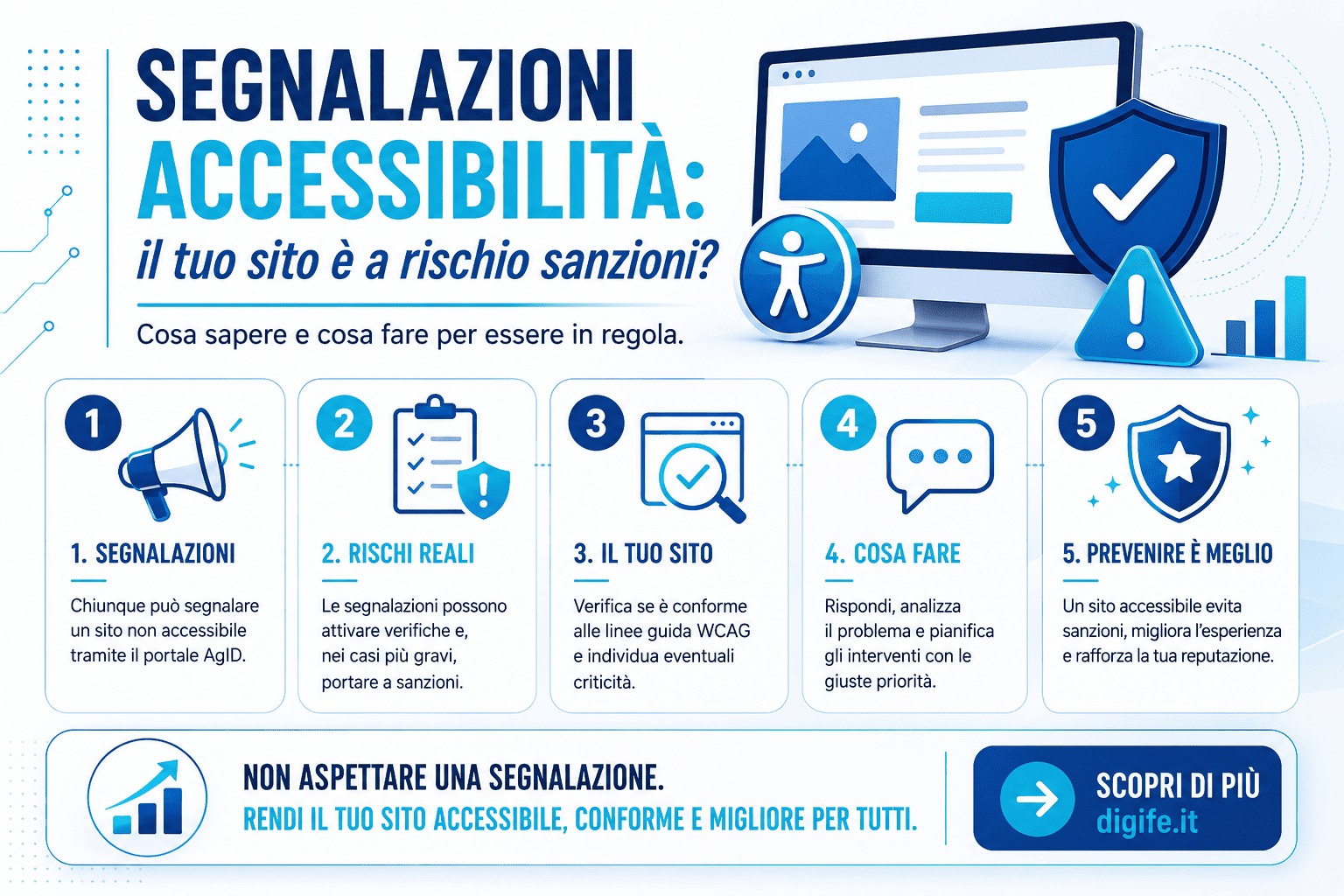
Accessibility Reports: The Mechanism That Exposes Your Site to AGID Sanctions
In today's digital landscape, accessibility is no longer a free choice or a simple aesthetic "plus." As highlighted by recent regulatory developments and the guidelines of the Agency for Digital Italy, owning a non-compliant website today represents a concrete and immediate risk. The core of this risk lies in an often underestimated element: reporting mechanism.
If your digital platform has barriers that prevent people with disabilities from navigating it, you're not just being "not inclusive," you're technically exposed to a sanctions procedure that any user can trigger with just a few clicks.
The AGID Portal: The New Frontier of Distributed Control
The regulatory reference is clear: the AGID has provided citizens with a powerful and direct tool. The accessibility reporting portal is not just a mailbox for complaints, but a real vigilance activator.
Previously, website compliance checks were sporadic or limited to random checks. Today, the paradigm has reversed. Any user who encounters a problem—whether it's an impossible-to-fill-out order form or a menu invisible to screen readers—can submit a formal report. This action forces AGID to take charge of the matter, transforming a technical problem into a potential violation of the law.
Who can report and why?
The feedback mechanism is open to everyone. However, it doesn't just concern the "big names" in public administration. With the extension of the obligations to private entities with certain revenue requirements (and in view of the imminent expiration of the European Accessibility Act), the range of sites "under fire" has expanded dramatically. An e-commerce site that prevents a blind user from completing a purchase is, in effect, a site at risk of fines.
The Reporting Cycle: From Notification to Fine
To understand the gravity of the situation, it's necessary to analyze the path a report takes once submitted. This isn't a process that falls into the void.
- Sending Feedback: According to the law, the user should first contact the site owner via the "Feedback Mechanism" (the mandatory link in the Accessibility Statement).
- The Owner's Inaction: If the company does not respond within 30 days or provides an unsatisfactory response, the user has the right to contact AGID directly through the "Digital Ombudsman" procedure.
- The Investigation: AGID launches a technical investigation. If the reported barriers are confirmed, the agency orders the site owner to remedy the problem within a set timeframe.
- The Sanction: If the company ignores the injunction or fails to demonstrate a credible compliance plan, administrative sanctions are triggered. These can be severe, with fines varying based on turnover and the severity of the discrimination detected.
What are the “Barriers” that generate reports?
To maintain your site's security focus, you need to understand what users report most frequently. Often, the risk isn't caused by glaring errors, but by technical details that frustrate the user experience.
1. Mouseless Navigation
Many modern websites are designed for touch or pointer navigation, but neglect keyboard navigation. If a user with motor disabilities can't scroll through your menu using the Tab key, your site is blocked. This is one of the easiest complaints to document and one of the most serious for AGID.
2. Absence of Textual Alternatives
An image that conveys information (such as an infographic or a graphical “Buy Now” button) without alt text (alt text) is a black hole for those who use assistive technologies. Without description, the user has no idea what they're clicking or looking at.
3. Contrasts and Readability
Many designers favor minimalist aesthetics with light gray text on a white background. For a visually impaired user, this makes the site inaccessible. If the contrast ratio doesn't meet WCAG 2.1 standards, a warning is almost guaranteed.
The Accessibility Statement: Your Shield (or Your Condemnation)
A crucial point underlined by the reference is the obligation of the Accessibility Statement. This document must be updated annually (by September 23) and must contain:
- The state of compliance (Satisfied, Partially Satisfied, Not Satisfied).
- The link to the feedback mechanism.
- Description of the inaccessible parts and justification (disproportionate burden).
Attention: Making false statements or failing to publish them is the quickest way to attract an inspection. If you claim your site is compliant but the user encounters obvious barriers, your legal position becomes more serious.
How to Protect Your Business and Prevent Fines
Proactively managing accessibility is the only way to prevent a report from turning into a fine. Here are the key steps:
Audit and Continuous Monitoring
The web is dynamic. Every time you update content, you could create a new barrier. It's essential to conduct periodic audits (automatic and manual) to ensure accessibility doesn't fall below the safe threshold.
Timely Response to Feedback
If you receive a report directly from a user, consider it a golden opportunity. Responding politely, acknowledging the problem, and providing a firm resolution date almost always prevents the user from escalating the complaint to AGID. Collaboration is your best defense.
Supplier Involvement
If your website is managed by an external agency, make sure compliance is an integral part of the contract. Too often, companies pay for "beautiful" websites that actually pose immense legal risks.
Accessibility is not a cost, it's IT Security
In conclusion, the risk of fines is real and growing. With the activation of the AGID reporting portals, control has been shifted into the hands of users. Don't wait for a registered letter or official notification to realize that your site is excluding a segment of the population.
Making a website accessible means protecting your investment, improving SEO, and, above all, preventing a trivial coding error from turning into a hefty financial penalty. Digital compliance is the new minimum standard of professionalism for any company that wants to call itself modern and responsible.
If you have any concerns about the health of your site, now is the right time to check it. Contact us to intervene