
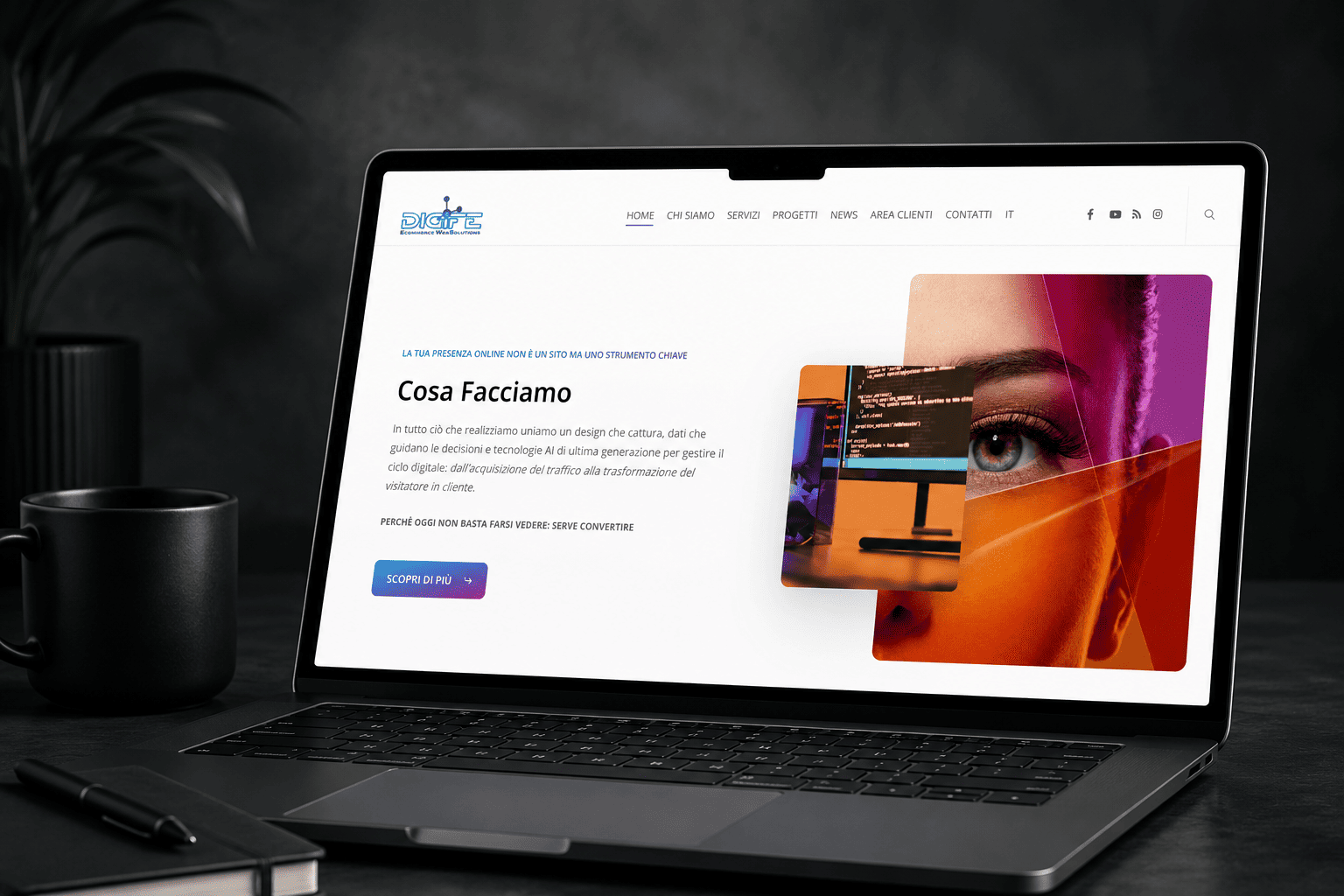
Today, creating a website has become simple. There are ready-made templates, platforms that promise to publish everything in a few hours, and artificial intelligence tools capable of generating text, images, and entire pages.
The result is that there are many more sites online than ever before. But not necessarily more sites capable of generating trust, inquiries, or sales.
While building a page has become easier, designing a truly compelling site has become much more complex. The web is full of companies using similar structures, interchangeable images, and messages so generic they could belong to anyone.
At Digife, we develop websites with WordPress because it allows us to build customized, manageable projects that can evolve with companies.
We don't choose it just because it's a well-known and widespread platform. We choose it because it offers the freedom needed to achieve what the project really needs to achieve.
The question, then, is not just whether WordPress is a good platform.
The right question is another:
Could it become the site your company really needs?
Being online doesn't mean having an effective website
Today, all you need is a template, some images, some automatically generated text and a “Contact us” to publish a site.
Technically, everything works. The pages open, the form submits the data, the site adapts to the smartphone, and the logo displays correctly.
But that doesn't mean the site is helping your business.
When someone visits your homepage, they should quickly understand what you do, who you're targeting, and why they should consider your offering.
She should acknowledge her problem, find answers to the doubts that are holding her back, and understand what step to take.
If this information isn't revealed, the visitor doesn't pursue it further. They return to the search results, visit a competitor, or postpone their decision.
The site is online, but it's not doing its job.
In these cases, the problem is rarely WordPress. The problem is what was built around WordPress.
The real advantage of WordPress is freedom
WordPress is often chosen because it is well-known, widespread, and seemingly easy to install.
For us, however, its most important advantage is another: it allows the project to evolve.
A website can start as a corporate presence and later integrate a blog, e-commerce, a reserved area, a booking system, a customer portal, or a connection to the management system.
It can be updated, expanded, and modified over time without necessarily having to start from scratch every time the company changes.
This freedom is especially useful when you don't want to limit yourself to publishing a showcase, but want to build a tool connected to your business.
Flexibility, however, produces value only when it is driven by a specific project.
Adding pages, plugins, and features without any logic doesn't make your site more complete. It often just makes it slower, harder to manage, and confusing for visitors.
More features do not make the site more effective
One of the most common mistakes is confusing the quantity of features with the quality of the project.
Your site can have chatbot , pop-ups, advanced forms, automations, reserved areas and dozens of integrations.
But if people don't understand what you offer or why they should choose your company, all these features risk adding complexity without producing any concrete results.
Each element should perform a specific task.
A page should help people understand. A form should facilitate contact. A section should answer a question. A testimonial should alleviate a doubt. A function should simplify the next step.
When an element does not help a person advance, it is not an advantage.
It's just more noise.
An effective website isn't just one that contains the most content. It's one that allows people to quickly find what they need to make decisions.
A template can speed up the work, but it does not replace the project
Templates allow you to start from a pre-built structure. They can reduce initial time and provide a clean graphic foundation.
The problem arises when the template is treated as if it were already a strategy.
The images are replaced, the logo is inserted, some text is modified and the site seems ready.
In reality, it is often just a filled structure.
The same phrases could be used by a competitor. The images could be from any industry. The pages show what the company does, but they don't explain why it should be chosen.
A template can be a starting point. It can't decide what information is truly important to your customers, what questions they need to address, and what path they should take.
These decisions must come before the design.
The simplest solution can become the most limiting one
Platforms that promise to create a website in minutes solve a specific need: publishing quickly.
For a simple or temporary project, they may even be sufficient. Difficulties arise when the company grows and needs to restructure, reposition, connect external tools, or develop specific functions.
It is at that moment that the initial simplicity can turn into a limitation.
What initially allowed you to move quickly can prevent you from customizing the path, properly managing content, or integrating the site with other company tools.
WordPress offers greater freedom of intervention. Even this freedom, however, must be managed expertly.
A flexible platform used without a clear direction can generate the same problems as a platform that is too closed.
A published site is not a finished project
Many companies consider a website a task to be completed.
The graphics are approved, the content is added, everything is checked to make sure it works, and it's published. From that moment, the project is considered complete.
Meanwhile, however, services, company priorities, customer questions, and the way people search for information are changing.
The site, however, continues to tell the story of a company that no longer exists in the same way.
An effective website should evolve with your business.
Content must be updated. Most-visited pages must be monitored. Forms must be checked. Requests received should help identify what information is missing and which steps are unclear.
Your website should do more than just introduce your company.
It should help the customer understand it, evaluate it and choose whether to contact it.
Being found is not enough if the page is not convincing
Many companies focus all their attention on traffic.
More visits are automatically considered a positive result. But bringing people to the site is only the first step.
The question that matters is:
What happens after the click?
The page must deliver on the promise made by the search result, ad, or social media content.
If the content is generic, if the most important information is difficult to find, or if the company's value isn't highlighted, even a good positioning can generate few requests.
SEO can help your site get found. It can't make an unclear offer compelling.
Advertising can bring people to your website. It can't fix what happens when they arrive.
Traffic opens the door. Content, structure, and credibility determine what happens next.
WordPress doesn't automatically make a site fast or secure.
WordPress can be fast, reliable, and easy to manage. It can also be slow, vulnerable, and difficult to maintain.
The difference depends on the decisions made during development and what happens after release.
A theme chosen solely for its look and feel may contain unnecessary features. Too many plugins can slow down loading times and increase vulnerabilities. Unoptimized images can make pages cluttered. Neglected updates can create security and compatibility issues.
Hosting also impacts performance, as do code quality, cache management, backups, and regular site audits.
The platform is the tool. Quality depends on how it is designed, configured, and maintained.
The site must be built around people
Before talking about WordPress, we at Digife start with the people who will use the site.
Who do you want to reach? What questions do your potential customers have? What stops them from trusting you? What information do they seek before contacting you? What alternatives are they considering? What truly makes your offering different?
They concern the way the customer makes a decision.
Without these answers, even a technically sound website risks remaining a simple digital showcase: tidy, modern, but of little use to the company.
The platform should be chosen after defining the objectives, path, contents and actions.
When WordPress is the right choice
WordPress can be an effective solution when your business needs a customizable, updatable, and growable website.
It's especially useful when you want to maintain control over your content, work on positioning, integrate external tools, or add new features over time.
It can be used to create corporate websites, blogs, information portals, e-commerce sites, reserved areas, and projects related to internal company processes.
However, it is not the right choice just because it is the most popular platform or because it allows you to start with apparently low costs.
The choice depends on the objectives, management needs, necessary integrations and the expected evolution of the project.
WordPress isn't always the answer.
But when the project requires freedom, control, and growth, it can become an extremely effective foundation.
Why we develop websites with WordPress at Digife
In Digife We use WordPress because it allows us to build customized, manageable sites that can evolve with the company.
However, let's not start from the graphic theme or the number of functions to install.
Let's start with what the site needs to achieve and what customers need to understand.
We analyze what your customers need to understand, what doubts are preventing them from taking action, what information needs to be revealed, and what path can lead them to contact or purchase.
Only then do we define the structure, content, design and technology.
We use WordPress not just as a system for publishing pages, but as the foundation of a tool connected to the company's goals.
Because a website shouldn't be built around what the platform allows you to do.
It should be built around what the customer needs to understand.
Decisions come before the tool
An effective website isn't based on the number of pages, the template you choose, or the number of plugins you install. It's based on decisions you make before development.
It's important to understand what the customer should perceive, what obstacles need to be removed, and what action should feel natural at the end of the journey.
We of Digife we develop websites WordPress, But let's not start with WordPress. Let's start with what's currently preventing your company's digital efforts from generating results.
Because the problem isn't having or not having a WordPress site. It's having an online site that doesn't give people enough reasons to understand, trust, and take action.