
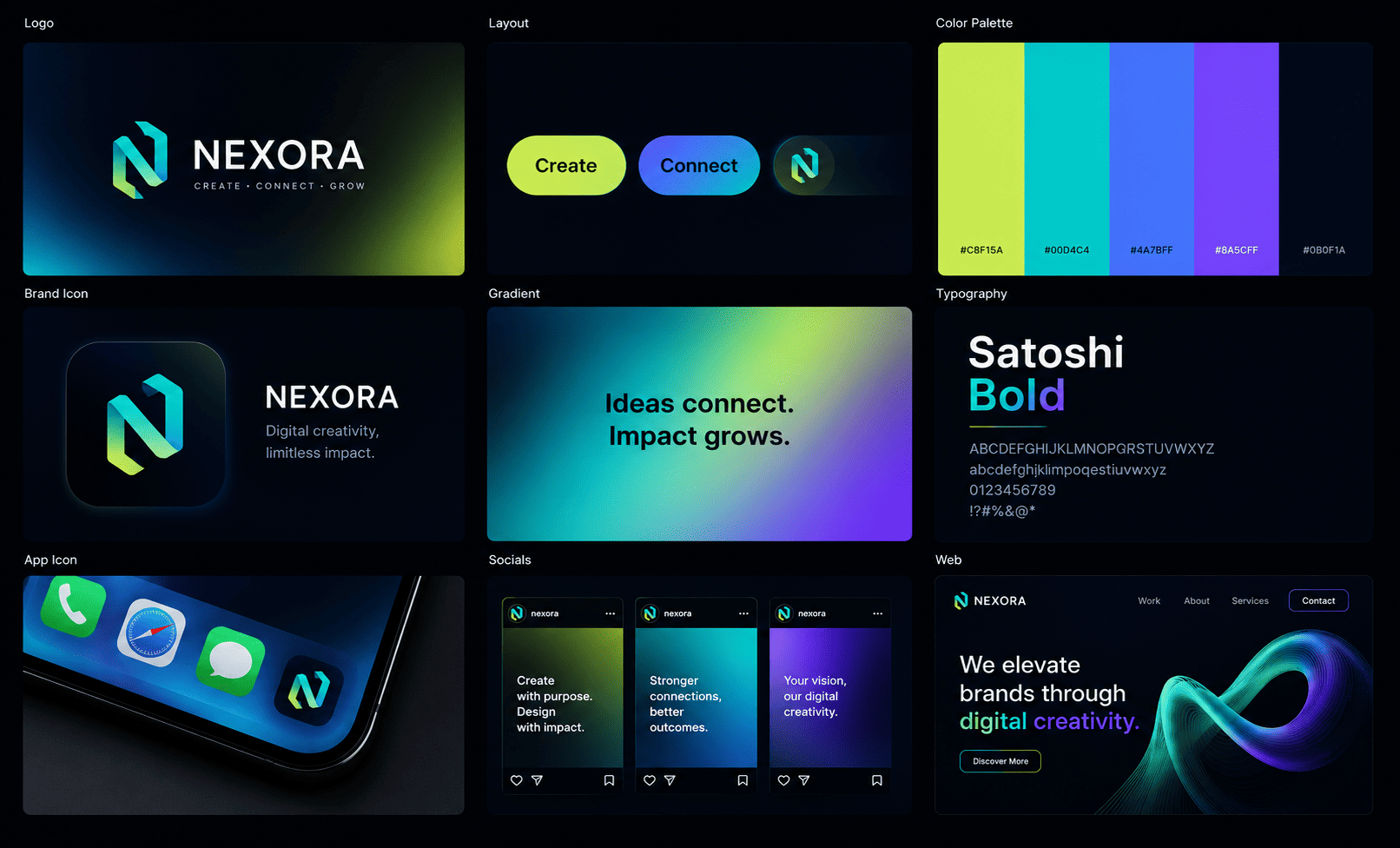
Many companies have a well-designed logo, a modern website, and updated social media profiles. Yet, when a person encounters the brand, they can't quite figure out what makes it different from the others.
The problem isn't always the quality of the graphics. Often, it lacks an identity that connects what the company displays, what it says, and how it behaves.
Brand identity serves precisely this purpose: to make the brand recognizable, consistent, and understandable across every touchpoint. It's not just about the logo, but the entire system with which a company presents itself and builds its perception over time.
What brand identity really is
Brand identity is the set of strategic, visual, verbal, and behavioral elements that define a brand.
It answers specific questions: who are we, what do we represent, what value do we offer, why should they choose us, and how do we want to be remembered?
These answers shouldn't emerge solely from a company presentation. They need to be perceived on the website, in social media content, advertising campaigns, emails, marketing materials, and in the customer experience.
This is why brand identity can't be reduced to the creation of a logo. The logo is one of the most visible elements, but it's not enough to explain the company's value, its positioning, or the reasons why it should be chosen.
An effective identity is a system. Each element must contribute to the same perception and reinforce all the others.
A well-designed logo does not automatically make a company recognizable.
Many branding projects begin with the choice of colors, fonts, and graphic design. This is understandable, because the visual aspect is the most immediate. The problem arises when the aesthetic is designed before the strategy.
A logo can be elegant, modern, and technically well-constructed, but still appear weak if it doesn't represent a clear position.
Customers don't choose a company simply because they like its brand. They choose it when they understand the problem it solves, the kind of experience it offers, and why they should trust it.
Before defining the image, you need to decide what that image needs to communicate. Without this foundation, you risk creating an identity that's beautiful to look at but difficult to remember.
The fundamental elements of brand identity
A complete brand identity is born from the intersection of strategy, visual identity, language, and behavior. These aren't independent components. They only work when they communicate the same idea.
Strategic identity
The strategic identity is the least visible part, but it guides all subsequent decisions. It includes the mission, values, positioning, brand promise, audience, and distinctive features of the offering.
It helps clarify what space the brand wants to occupy in people's minds.
Saying you're professional, reliable, innovative, or customer-focused isn't enough. These concepts are used by almost every company, and precisely because of this, they don't really make a difference.
Effective positioning must explain what problem is being addressed, for whom, with what approach, and with what advantage over alternatives.
The central question is not just “What do we sell?”, but “Why should someone choose us?”
Visual identity
The visual identity includes all the graphic elements that allow the public to recognize the brand: logo, color palette, typography, grids, layouts, icons, photographic style, illustrations, patterns and textures.
Their purpose isn't simply to make materials look better. They must create continuity across different channels and content.
If the website uses a sleek style, social media changes with every post, and presentations use different colors and fonts, the audience receives fragmented signals. The company appears less structured and becomes harder to remember.
Visual consistency reduces this distance and allows you to recognize the brand even before reading its name.
Verbal identity
Every company uses words, but not all have a verbal identity.
Verbal identity defines the tone of voice, vocabulary, sentence rhythm, key messages, claims, and the rules that guide writing.
A brand can be authoritative without appearing distant, simple without appearing superficial, direct without becoming aggressive. These characteristics don't emerge by chance. They must be defined and applied consistently.
When the website communicates formally, social media uses an ironic tone, and commercial emails come across as impersonal, the perception of the brand is constantly changing.
Recognizability doesn't just depend on what a brand displays. It also depends on how it formulates a headline, presents a service, responds to a customer, or constructs a call to action.
Behavioral identity
Brand identity also includes how the company operates.
If a brand promises simplicity, but the purchasing process is complicated, there's a contradiction. If it communicates closeness to the customer, but responds slowly or impersonally, the promise loses credibility.
Behavioral identity is about service, support, the business process, problem management, and the overall experience you provide to your people.
A brand isn't judged solely by what it says. It's judged above all by what happens next.
What is an effective brand identity for?
A well-constructed brand identity helps a company stand out in markets where products, services, and communications increasingly seem similar.
It allows you to be recognized faster, communicate value more clearly, and maintain consistency across your website, social media, advertising, presentations, and offline materials.
This consistency builds familiarity. Familiarity, over time, contributes to trust.
Brand identity also offers internal guidance. It helps employees, suppliers, and partners understand how to present the brand, which messages to use, and which choices to avoid.
When these rules don't exist, every new piece of content starts from scratch. Images, colors, and words are chosen based on current taste, resulting in discontinuous communication.
The result is a company present on many channels, but without a recognizable form.
How to build a brand identity
Building a brand identity doesn't mean starting with the logo. It means follow a process which starts from analysis and arrives at concrete applications.
Analyze the market, the public and the current perception
The first step is to understand the context in which the brand operates.
It is necessary to observe the market, competitors, public expectations, the company's strengths and existing perceptions.
The analysis must also identify the elements that make the brand too similar to others. If all companies in the industry use the same colors, images, and messaging, repeating those codes makes the brand recognizable as belonging to the category, but not necessarily distinguishable.
The goal isn't to be different at all costs. It's to understand what elements can make the company identifiable without distancing it from the public's expectations.
Define brand positioning
After the analysis, it is necessary to clarify the position that the brand wants to occupy.
Positioning must explain who the company is targeting, what problem it solves, what benefits it offers, and why its approach is different.
This step allows you to avoid generic messages like "quality and professionalism," "innovation," or "tailor-made solutions." These are formulas used by many companies and don't help the customer make a decision.
A clear position, on the other hand, makes all subsequent decisions easier: from tone of voice to site structure, from advertising campaigns to content.
Identify a central creative concept
The creative concept translates the strategy into an understandable visual and verbal direction.
It's not a slogan chosen to attract attention. It's the idea that connects the brand's meaning to its applications.
An effective concept allows you to maintain consistency even when formats change. A web page, video, campaign, or social media post may use different solutions, but they must continue to communicate the same identity.
Without a central direction, the brand tends to change style and language based on the project at hand.
Designing the visual and verbal identity
Once the strategy has been defined, the visual and verbal system can be developed.
Graphics must be designed to work in real-world applications, not just for the initial presentation. The logo must be legible at different sizes, the colors must work both on screen and in print, the typography must ensure clarity, and the layouts must adapt to various formats.
Tone of voice must also be concretely applicable. It's not enough to describe it with generic adjectives. You need to demonstrate how to write headlines, presentations, emails, posts, calls to action, and customer responses.
Identity becomes useful when it reduces improvisation.
Verify the system in real applications
A brand identity is not evaluated by simply looking at the logo against a neutral background.
It must be verified on the website, on social media, in presentations, advertising campaigns, videos, packaging and commercial materials.
This step allows us to understand whether the system is truly flexible, readable and recognizable.
An identity that's too rigid becomes difficult to apply. An identity that's too generic changes constantly and loses its effectiveness. The system must offer clear rules, but also enough scope to adapt to different contexts.
Create a brandbook
The brandbook is the document that collects the rules of brand identity.
This can include logo versions, minimum dimensions, clear areas, colors, fonts, layouts, image styles, icons, tone of voice, key messages, and pitfalls to avoid.
It's not just useful for designers. It's a practical tool for anyone producing corporate communications.
Without a shared manual, each supplier interprets the brand differently. With clear rules, the brand identity can grow without losing continuity.
Mistakes that make a brand less recognizable
One of the most common mistakes is starting from aesthetics without having defined the positioning.
In these cases, colors, fonts, and images are chosen primarily based on personal taste. The result may appear pleasing, but it doesn't necessarily convey something distinctive.
Another mistake is neglecting verbal identity. The brand maintains the same colors, but changes tone across every channel, using institutional language on the website, informal on social media, and impersonal in commercial communications.
Changing style with each campaign also weakens brand recognition. Constantly trying something new may seem creative, but it prevents audiences from associating stable signals with the company.
Finally, many companies imitate the codes of their industry. This choice makes them easily classifiable, but often also interchangeable.
The problem isn't appearing outdated. It's appearing like everyone else.
The characteristics of a brand identity that works
The most effective identities are simple, consistent, distinctive, and scalable.
They're simple because the audience should be able to recognize them without decoding too many elements. They're consistent because they maintain the same principles across different touchpoints.
They're distinctive because they use signals, messages, and choices that differentiate them. They're scalable because they work across a web page, social media content, presentation, video, or physical material.
Simplicity doesn't mean visual poverty. It means eliminating anything that doesn't contribute to recognizability.
Consistency doesn't mean always publishing the same content. It means allowing your brand to change formats without losing its identity.
How to choose a brand identity agency
Choosing an agency shouldn't be based solely on the aesthetic quality of the portfolio.
It's important to understand how the analysis phase is approached, how positioning is defined, and how the strategy is transformed into concrete applications.
An effective project requires diverse skills: strategy, design, copywriting, web development, content, and communications. These elements must work together.
It is therefore necessary to evaluate the process, the ability to listen, the clarity of the phases and the attention to the company's operational needs.
A brand identity shouldn't just work during the project presentation. It must continue to work when used every day by different people, departments, and suppliers.
Why brand identity is even more important today
Companies are publishing more content, using more platforms, and competing for attention in increasingly crowded spaces.
Being present doesn't guarantee recognition. Publishing frequently doesn't automatically build a reputation.
When every piece of content looks different, every campaign uses new language, and every page communicates a different promise, the company increases its presence but weakens its identity.
An effective brand identity connects all these elements and offers people a stable, understandable and credible image.
The point isn't just to be recognizable. It's to ensure that that recognizability communicates a concrete reason for choosing the brand.
Building an identity means clarifying why you chose the brand
Brand identity isn't an isolated aesthetic intervention. It's the system that transforms strategy, image, words, and experience into a coherent perception.
Before changing your logo, colors, or website, you need to understand what your audience should recognize and remember about your company.
If identity doesn't express difference, even well-crafted communication risks becoming confused with everything else.
Digife It analyzes what the brand communicates today, identifies where it is losing recognition, and builds a visual, verbal, and strategic system capable of working across different touchpoints.
Because having a coordinated image isn't enough. You need to give people a clear reason to remember and choose you.