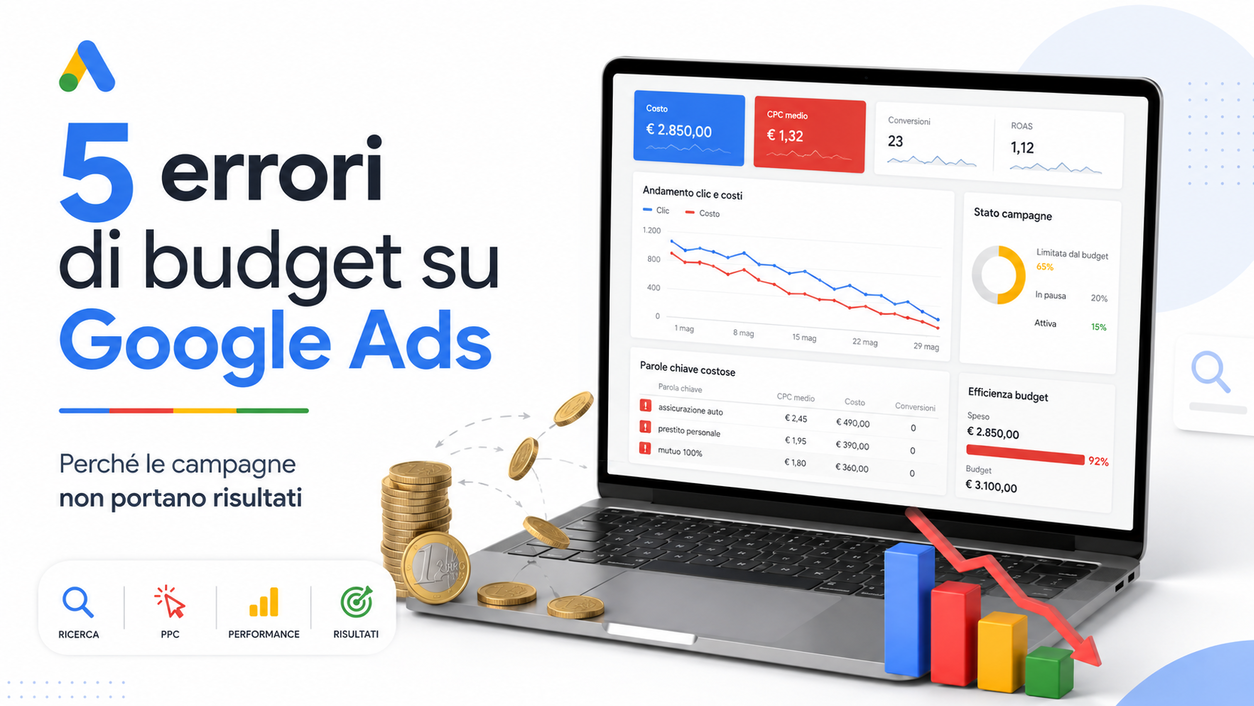
In most cases, the platform is unfairly accused of “not working,” but the real problem is almost never the tool itself.
When we analyze historical data, the reality is quite different: advertising budgets are allocated haphazardly, campaigns lack clear business objectives, and landing pages are not structured to convert clicks into leads.
As a result, Google Ads campaigns don't deliver results and the investment turns into a cost.
In this article we will delve into the 5 Google Ads Budget Mistakes which we encounter most often in companies and we will see how to optimize the investment to put the numbers back on your side.
1. Launching campaigns without clear business objectives and KPIs
Too often, companies decide to invest in Google advertising by setting an arbitrary monthly budget, for example 300 or 500 euros, guided by the logic of "let's put in a little budget and see how it goes.".
This is the first reason why Google Ads doesn't bring results.
We focus exclusively on vanity metrics, such as the number of clicks generated or ad views, completely ignoring the data that determines a company's commercial success.
Launching a campaign without calculating margins means moving in the dark, risking exhausting resources on low-profit products or services or in non-strategic geographic areas.
Before activating any campaign, you need to define these 4 parameters:
| Strategic KPI | What does it specifically define? |
|---|---|
| Maximum sustainable CPA | The maximum cost a company can spend to acquire a single customer while remaining profitable. |
| Average request value | The estimated economic value of a contact based on the close rate. |
| Product or service priority | Which business solutions have the highest margin and deserve the largest share of the budget. |
| Realistic geotargeting | The precise selection of geographic areas in which the sales force or logistics are competitive. |
2. Choosing keywords that are too general and ignoring negative keywords
A classic mistake that quickly drains your Google Ads budget is choosing keywords that are too generic.
Many advertisers are drawn to high search volumes, thinking that "more traffic" equals "more customers." In the reality of performance marketing, this isn't the case.
There is a clear difference in terms of search intent:
- Informational intent: High volume, low conversion. A user searching for "how a photovoltaic system works" is simply looking for information. Paying for this click is a waste of your budget.
- Commercial intent: Low volume, high conversion. A user searching for "B2B photovoltaic installation quote" has a concrete need and is closer to making a decision.
If your Google Ads campaigns aren't working, you're most likely paying to intercept informational queries.
Added to this is the failure to optimize negative keywords, i.e. terms you don't want to appear for, such as "free," "do it yourself," or "manual.".
Without an updated exclusion list, Google will distribute your budget across completely off-target searches.
3. Driving paid traffic to an unoptimized landing page
You can design the perfect ad and target the ideal keyword at the lowest cost per click on the market, but if the user lands on the wrong page, your conversion rate will be zero.
Direct traffic to Google Ads on the home page of your company website is one of the most costly mistakes.
The user finds himself lost among the navigation menus, finds no immediate response to what he read in the ad, and abandons the site within a few seconds.
The main elements that block conversions are:
- Slow loading from mobile: If the page takes too long to load, the user goes back and the click has still been paid for.
- Lack of consistency between ad and page: If the ad promises a specific solution and the page talks about the company in general terms, the user loses trust.
- Lack of social proof: Sites without reviews, case studies, or certifications convey less trust.
- Complex contact forms: Forms with too many required fields can drastically reduce conversions.
Quick check of your landing page
- Does the user immediately find the exact solution they read about in the ad?
- Is it clear, in less than 5 seconds, what action is required?
- Are there visual trust elements such as logos, reviews, or certificates?
4. Tracking “dirty” conversions and confusing the algorithm
Today, Google's advertising platform relies heavily on artificial intelligence and automated bidding strategies.
The algorithm learns and optimizes based on the conversion data it receives. If the tracking system is poorly configured, the algorithm will learn to do the wrong thing.
This happens when simple micro-actions, such as clicking on a menu, scrolling a page, or clicking on a phone number, are tracked as primary conversions without verifying whether the call actually originated.
If the algorithm receives “dirty” data, it will look for users who are only likely to perform those superficial actions, ignoring those who are actually interested in filling out a quote request form or completing a purchase.
Without accurate and clean conversion tracking, budget optimization becomes impossible.
5. Stopping campaigns prematurely due to lack of patience
In digital marketing, haste is a bad advisor.
Many entrepreneurs launch a new campaign and, if they don't see results within the first 48 hours, panic: they continually adjust their budgets, change keywords, or choose to shut everything down too soon.
Every time you launch or structurally modify a campaign, Google enters a technical phase called the learning phase.
The system needs to test combinations of audiences, times, and placements to understand how to optimize spend.
Especially when operating on a tight budget, it is essential to plan a minimum testing period of 4-8 weeks.
This time interval is necessary to collect a useful amount of data on which to base subsequent optimizations, avoiding making decisions dictated by emotion.
Summary: Is your Google Ads budget working properly?
Check the health of your advertising account with this checklist:
- Calculated CPA: Do you know the maximum sustainable cost per acquisition for your business?
- Focused objectives: Do your campaigns target clear macro-commercial objectives?
- Commercial search intent: Do the queries you pay for demonstrate real purchase intent?
- High-performance landing page: Do the ads link to specific, fast, and consistent pages with the ad copy?
- Updated negative keywords: Is there a list of exclusions that is regularly analyzed and expanded?
- Clean tracking: Are only actions that generate real economic value counted as conversions?
The DigiFe strategic approach
In DigiFe We analyze corporate accounts penalized by these strategic errors.
Our philosophy as an agency is based on a precise principle: Before touching the Google Ads platform or setting the budget, we analyze operating margins, commercial priorities and geographic sustainability of the business.
Without this preliminary planning, any investment risks turning into a wasted expense.
Our method is not limited to ad setup.
Let's build a digital ecosystem: we analyze search terms to reduce waste, clean up tracking through Google Tag Manager and connect the data to the company CRM.
Additionally, we optimize the user experience on landing pages so that every click has a real chance of converting into a contact.
A website shouldn't just be beautiful. It should be designed to generate leads and business opportunities.
Don't stop Google Ads: optimize the ecosystem that surrounds it.
Google Ads can be one of the most powerful revenue accelerators for businesses, but only if the surrounding infrastructure is structured to convert clicks into real customers.
If your current investments aren't bringing the desired returns, the solution is almost never to stop your campaigns.
The priority is to identify marketing bottlenecks, clean up tracking data, and optimize landing pages.
The DigiFe team performs in-depth audits of your online presence to identify budget leaks and build a strategic, sustainable, and scalable optimization plan.
Want to find out where your Google Ads advertising investment is going?
Let's start with a concrete analysis of campaigns, landing pages, tracking, and user journeys.
In DigiFe We develop projects based on real business data, not on simple commercial promises.