
Many companies think the problem is generating more leads.
In reality, the real limit is often another: Marketing and sales don't share the same information, don't read the same data, and don't work on the same process..
This means investing time and budget to acquire leads that are then managed poorly, followed up too late, or evaluated using different criteria from department to department.
Marketing says, “We brought leads.”.
Sales replies: “They are cold contacts, they are not in target.”.
In the meantime, the company loses something much more important than the internal discussion: real business opportunities.
For this reason, today information sharing in companies cannot be seen as an organizational detail.
It must become a system.
A system capable of connecting campaigns, leads, negotiations, sales feedback, customer data, and financial results.
The problem isn't just getting marketing and sales to talk.
The problem is getting them to work on the same truth.
When marketing and sales are not aligned, the company loses value
In many SMEs it happens every day.
Marketing invests budgets in campaigns, content, trade shows, newsletters, landing pages, and lead generation activities.
Contacts are coming.
The names are passed on to the sales people.
At that point the friction begins.
For marketing, those leads are the result of precise work.
For salespeople, these are often contacts that need to be verified, people who aren't ready, vague requests, or opportunities that aren't yet ripe.
Marketing accuses sales of not following up enough with leads.
Sales accuses marketing of generating low-qualified leads.
And no one can really figure out where the process gets stuck.
The point is that, without shared data, each department defends its own perception.
Marketing looks at clicks, completed forms, cost per lead, and active campaigns.
Sales looks at phone calls, quotes, closed deals, and the actual quality of the contact.
Both have some truth to them.
But no one sees the whole journey.
When data remains separate, decisions also become partial.
The problem: Corporate silos don't just waste time, they waste conversions.
The term “corporate silos” refers to departments that work within the same company, but with separate information, tools, and goals.
Marketing on one side.
Sales on the other.
Assistance from yet another.
Administration with other data.
Management with reports reconstructed after the fact.
The result is fragmented management.
And fragmentation produces very concrete effects.
A lead is passed without context.
A salesperson calls without knowing what the customer saw.
Marketing does not receive feedback on the outcome of the deal.
Management doesn't understand which channels generate real sales.
The customer receives inconsistent communications.
According to the’Adobe 2026 AI and Digital Trends Report, Generative AI and agentic AI are transforming the customer journey faster than many organizations can adapt. This makes it even more important to have connected data, clear processes, and departments capable of understanding the same customer journey.
Silos aren't just an internal problem.
They are a barrier to conversion.
If marketing and sales don't share information, the company risks:
- wasting advertising budget;
- lose hot leads;
- follow up on unqualified leads;
- create internal tensions;
- measuring the wrong KPIs;
- making decisions on incomplete data;
- reduce the quality of the customer experience.
The consequence is simple.
Generating contacts is not enough.
We need a process that can transform them into deals and customers.
Why Leads Don't Really Work
When a salesperson says “these leads aren’t working,” the problem is often not the lead itself.
The problem is that the context is missing.
The salesman doesn't know:
- which campaign the contact comes from;
- what service did you request;
- which pages of the site you visited;
- which emails he opened;
- what content you downloaded;
- what problem did he express;
- how close is he to the decision;
- What message did you receive before the call?.
Without this information, the contact is treated as just another name.
And this immediately reduces the chances of conversion.
A lead generated from a “CRM for SMEs” campaign should not be handled in the same way as a contact arriving from a generic inquiry.
A person who has read three articles, downloaded a guide, and filled out a form has a different level of interest than someone who left a contact after a superficial interaction.
The problem is that without sharing information, these differences don't emerge.
A lead without context is just a name.
A lead with data, history, and behavior becomes a business opportunity.
Lack of feedback blocks improvement
Information sharing shouldn't just be from marketing to sales.
It must also work the other way around.
Marketing needs to know what happens after the lead passes through.
Did the contact respond?
Was he really interested?
Did you request a quote?
Did he refuse?
Have you chosen a competitor?
Was it off target?
Was it too low budget?
Was there a real urgency?
Did he close the deal?
Without this information, marketing continues to optimize campaigns based on partial metrics.
Click.
Impression.
Cost per lead.
Form conversion rate.
This is useful data.
But they are not enough.
Because a campaign can generate many low-cost leads and few sales.
Another may generate fewer leads, but more valuable deals.
Without sales feedback, this difference remains invisible.
The academic research VALOR: Value-Aware Revenue Uplift Modeling for B2B Sales, published in 2026, highlights the importance of identifying the accounts with the greatest potential for value and optimizing sales resources not only on volume, but on the probability of generating real revenue.
This confirms a clear direction: marketing and sales can no longer think only about the quantity of contacts.
They have to think about value.
Marketing shouldn't just measure how many leads it generates.
You need to understand which leads become valuable.
The new vision: not marketing versus sales, but a single growth process
The real leap in quality occurs when the company stops seeing marketing and sales as separate departments.
They are not two different worlds.
They are two parts of the same path.
Marketing creates attention, interest and trust.
Sales turns that interest into relationship, negotiation, and outcome.
If the connection between the two phases is missing, the conversion stops.
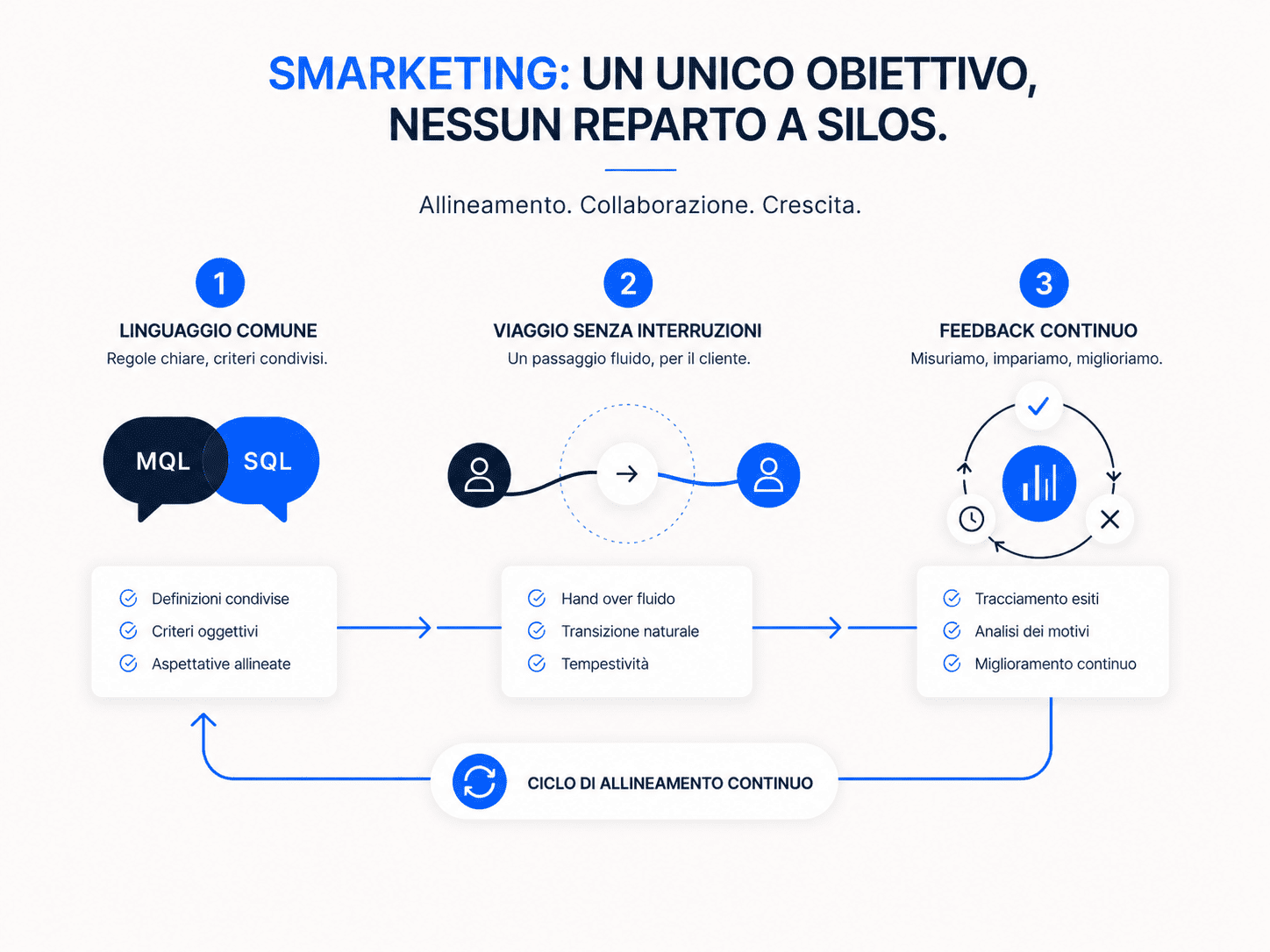
This is why today we often talk about Smarketing, that is, the operational alignment between Sales and Marketing.
But the point is not to use a new word.
The point is to build a shared process.
A process in which:
- marketing knows which leads become customers;
- Sales knows the contact's path before the call;
- management sees complete data;
- KPIs are shared;
- feedback comes back;
- content is created based on real objections;
- Campaigns are optimized for commercial quality, not just contact volume.
University of Lausanne Executive Education, in an in-depth analysis on the alignment between marketing and sales, emphasizes that tools alone are not enough: a managerial role capable of keeping the system aligned over time is also needed.
This is a crucial point.
CRM helps.
But without method, accountability, and ongoing review, even the best software risks becoming just another disconnected archive.
Sales and marketing shouldn't chase each other.
They have to work within the same system.
1. Define a common language
The first step in aligning sales and marketing is to create shared definitions.
Many tensions arise because departments use the same words with different meanings.
For marketing, a lead can be anyone who has filled out a form.
For sales, a valid lead is someone with a clear need, a viable budget, and a concrete interest.
If these definitions are not clarified, conflict is inevitable.
It is therefore necessary to establish objective criteria.
For example:
- what is a lead;
- when a lead becomes MQL, Marketing Qualified Lead;
- when a lead becomes SQL, Sales Qualified Lead;
- within what time frame must he be contacted again;
- what minimum information must be collected;
- what behaviors indicate real interest;
- when a contact needs to return to marketing to be nurtured;
- when a negotiation can be considered lost.
This creates a common language.
And common language reduces interpretations.
If marketing and sales don't share definitions, they can't share results.
2. Map the transition from lead to deal
The second step is to map the lead journey.
From first contact to closing.
How does the lead arrive?
From which channel?
With what message?
Who takes charge of it?
Within how much time?
What data is passed to sales?
What happens if he doesn't respond?
When is a quote sent?
Who does follow-up?
How is the outcome recorded?
Without this map, the transition between marketing and sales remains fragile.
Marketing “passes the contact”.
Sales “works it”.
But no one really controls the route.
The risk is that leads get lost right at the most delicate point: the transition from interest to commercial relationship.
The lead handover does not have to be a sending of names.
It must be a structured passage of information.
3. Create a continuous feedback loop
The third element is feedback.
Every negotiation must produce useful information.
Not just “won” or “lost”.
But also the why.
For example:
- over budget;
- not on target;
- too long times;
- competitor already chosen;
- inconsistent request;
- failure to respond;
- future interest;
- real but not urgent need;
- lost negotiation on price;
- negotiation lost due to lack of trust;
- negotiation won thanks to content or case studies.
This data is valuable.
Because they help marketing improve campaigns, content, targeting, and messages.
And they help sales prepare better arguments.
Feedback should not be occasional.
It must enter the process.
Every lost negotiation can become useful data to improve the next one.
4. Share KPIs that measure value, not just activity
A common mistake is measuring marketing and sales with disconnected KPIs.
Marketing measures leads generated, cost per contact, traffic, impressions, and form conversion rate.
Sales measures quotes, deals, closings, and revenue.
These are useful metrics.
But if they remain separate, they do not tell the complete story.
It is necessary to introduce shared KPIs, such as:
| Shared KPI | Why it matters |
|---|---|
| Qualified leads | Measure contact quality, not just volume |
| MQL to SQL rate | Indicates how many marketing leads are accepted by sales |
| Average response time | Measures the speed at which the lead is handled |
| Lead to deal conversion rate | Shows if contacts generate real opportunities |
| Conversion rate from deal to customer | Measure commercial effectiveness |
| Average value of opportunities | Helps understand which channels bring in the most profitable leads |
| Reasons for loss | They transform failures into strategic data |
| Revenue attributed to marketing | Connect campaigns and revenue |
If the data remains separate, the KPIs remain incomplete.
Marketing doesn't have to win if it generates lots of leads.
It must win if it helps generate concrete opportunities.
CRM as the single source of truth
Smarketing cannot work if each department uses different tools.
Marketing on a platform.
Sales in Excel.
Email support.
Direction on manual reports.
Administration on another management system.
In this scenario, information sharing becomes slow and incomplete.
We need a single source of truth.
CRM can play just this role.
Not as a simple contact archive.
But as a shared environment where to collect:
- personal data;
- lead source;
- country of origin;
- contents consulted;
- open emails;
- completed forms;
- lead status;
- interest score;
- assigned commercial;
- activities carried out;
- notes;
- estimates;
- negotiations;
- results;
- reasons for loss;
- economic value;
- reports and dashboards.
This is precisely the value of CRM.
It allows marketing and sales to see the same path.
And when two departments see the same path, they can improve it together.
CRM isn't just about managing contacts.
It helps connect data, people, and conversions.
What changes when sales and marketing share information?
When information starts to flow, it changes the way the company works.
Sales calls with more context
It doesn't start from scratch.
It knows where the lead comes from, what they requested, what content they read, what service they looked at, and what problem they might have.
The call becomes more precise.
Less generic.
Less improvised.
More useful.
Marketing improves campaigns
Don't just look at the leads generated.
See which leads become deals.
Understands which messages attract better leads.
Identify which channels bring the most profitable opportunities.
Optimize your budget not just on cost, but on value.
Management makes better decisions
You no longer have to reconstruct the data after the fact.
You can see the entire route:
campaign → lead → sales → negotiation → quote → customer.
This allows you to understand where the process works and where it gets stuck.
The customer experiences a more consistent experience
Does not receive disconnected communications.
You must not repeat information already given.
He does not perceive confusing transitions between departments.
He sees a more organized, more attentive and more professional company.
The budget is used better
When marketing and sales share data, it becomes easier to understand which activities generate real value.
This reduces waste and improves return on investment.
Every piece of data shared reduces a blind spot in the business process.
AI, automation and shared data
In 2026, the topic of sales and marketing alignment becomes even more important for AI as well.
Because AI only works well if the data is reliable, clean, and connected.
If data is duplicated, incomplete, or scattered across different tools, automation, scoring, and analytics become weak.
A well-structured CRM system allows you to make better use of:
- lead scoring;
- follow-up automations;
- segmentation;
- personalized emails;
- business tips;
- predictive dashboards;
- source analysis;
- conversion reports;
- behavior-based campaigns.
L'Adobe's insight into personalization at scale It highlights how data, content, and governance are crucial to creating more relevant and consistent experiences. Without shared information, personalization remains weak and difficult to scale.
This means that AI does not solve the mess.
It amplifies it, if the data is dirty.
Or it turns it into an advantage, if the data is organized.
Before you automate, you need to align.
Before using AI, you need to build reliable data.
How to align sales and marketing: an operational method
Alignment doesn't come from a motivational meeting.
It arises from a process.
1. Analyze the current flow
First we need to understand how leads are generated, passed on, and managed today.
Which channels do they come from?
Who receives them?
How are they qualified?
How long does it take before we get back in touch?
Where is the information recorded?
What happens if the lead isn't ready?
How is the result updated?
This analysis shows the bottlenecks.
2. Define shared rules
Marketing and sales must establish clear criteria together.
When a lead is qualified.
When it should be assigned.
By when should it be recalled?.
When he returns to marketing.
What data needs to be recorded.
What outcomes should be tracked?.
Rules reduce conflict and interpretation.
3. Centralize information
All data must flow into a shared system.
Not to control people.
But to give each department the context it needs to work better.
4. Connect CRM, website and campaigns
Website forms, landing pages, Ads campaigns, and email activities must communicate with the CRM.
In this way the lead does not enter the company as a simple name.
Come in with a story.
5. Create shared dashboards
Marketing, sales, and management need to be able to read the same data.
Not all data.
The right ones.
Leads generated.
Qualified leads.
Follow-ups completed.
Negotiations are open.
Quotes sent.
Closed contracts.
Reasons for loss.
Revenue generated.
6. Review the process periodically
The alignment is not final.
It needs to be monitored.
Every month or quarter you need to analyze:
- lead quality;
- response times;
- conversions;
- frequent objections;
- more effective campaigns;
- more useful business materials;
- reasons for loss;
- opportunities for improvement.
This turns sales and marketing into a continuous learning system.
Mistakes to avoid
Passing leads without context
Sending a contact name to a salesperson without information about the source, interest, behavior, and request immediately reduces the effectiveness of the contact.
Measure only the number of leads
Having lots of leads doesn't mean having lots of opportunities.
What matters is the quality, the promptness, and the likelihood of turning them into deals.
Do not record trading results
If sales doesn't update the outcome of deals, marketing can't improve.
Business feedback is a strategic source.
Use separate tools
If marketing and sales work on different platforms, the data breaks down.
And when the data breaks down, the customer journey becomes difficult to manage.
Confusing automation and strategy
Automating a bad process means making it faster, not better.
First, the method is defined.
Then it gets automated.
Checklist: Are sales and marketing truly aligned?
| Request | What does it indicate? |
|---|---|
| Do marketing and sales share the same definition of a qualified lead? | There is a common language |
| Are leads assigned with clear timeframes and rules? | The passage is structured |
| Do salespeople see the lead source and history? | The sale starts with more context |
| Does marketing receive feedback on business outcomes? | Campaigns can improve |
| Are your CRM, website, forms, and campaigns connected? | The data is not lost |
| Are there shared dashboards? | Management and departments read the same results |
| Are reasons for loss and objections tracked? | Negotiations generate learning |
| Do KPIs measure quality and revenue, not just quantity? | The focus is on real growth |
If many answers are negative, the problem is not just communication.
It's a system problem.
FAQ on information sharing between sales and marketing
Why should sales and marketing be aligned?
Because both work on the same customer journey. Marketing generates attention and leads, while sales converts those leads into deals and customers. If the two departments don't share data and feedback, the process loses effectiveness.
What is Smarketing?
Smarketing is the alignment between Sales and Marketing. It means creating shared goals, processes, definitions, data, and KPIs to improve lead quality and increase conversions.
What is an MQL?
An MQL, Marketing Qualified Lead, is a contact who has shown enough signs of interest to be considered potentially useful by marketing.
What is SQL?
A SQL, Sales Qualified Lead, is a contact that sales considers ready for more direct sales management, because he or she has a concrete need, interest, context, or potential.
How do you improve the progression of leads from marketing to sales?
It improves by defining clear criteria, response times, mandatory data, automatic assignments, follow-up activities, and feedback on outcomes.
Does CRM really help align sales and marketing?
Yes. A CRM centralizes information, history, campaigns, leads, sales activities, deals, and reports. This allows marketing and sales to work together on the same data and coordinate better.
Which KPIs should you use to measure alignment?
The key KPIs are MQL to SQL rate, re-engagement time, lead-to-deal conversion rate, close rate, marketing revenue, average opportunity value, and churn reasons.
Conclusion
Sales and marketing shouldn't be at war.
They must share information, data and responsibilities.
When these departments work separately, the company loses budget, time, and opportunities.
Marketing generates leads without knowing which ones become customers.
Sales works leads without knowing the context.
Management makes decisions on incomplete reports.
The customer experiences a less consistent experience.
The solution is not to ask one department to do better on its own.
The solution is to build a shared system.
A system where every lead has a story, every deal produces data, every campaign is measured for value, and every department works toward the same goal: turning interest into opportunities and opportunities into results.
Generating leads isn't enough.
We need to build a process capable of converting them.
Want to understand where sales and marketing are losing information, time, and opportunities?
DigiFe Analyze your lead generation flows, the transition between marketing and sales, data management and the points where the process loses value.
Then set up a custom CRM solution to centralize information, improve follow-ups, and help your team work toward shared data, clear goals, and measurable conversions.
Align marketing and sales with DigiFe consulting.