
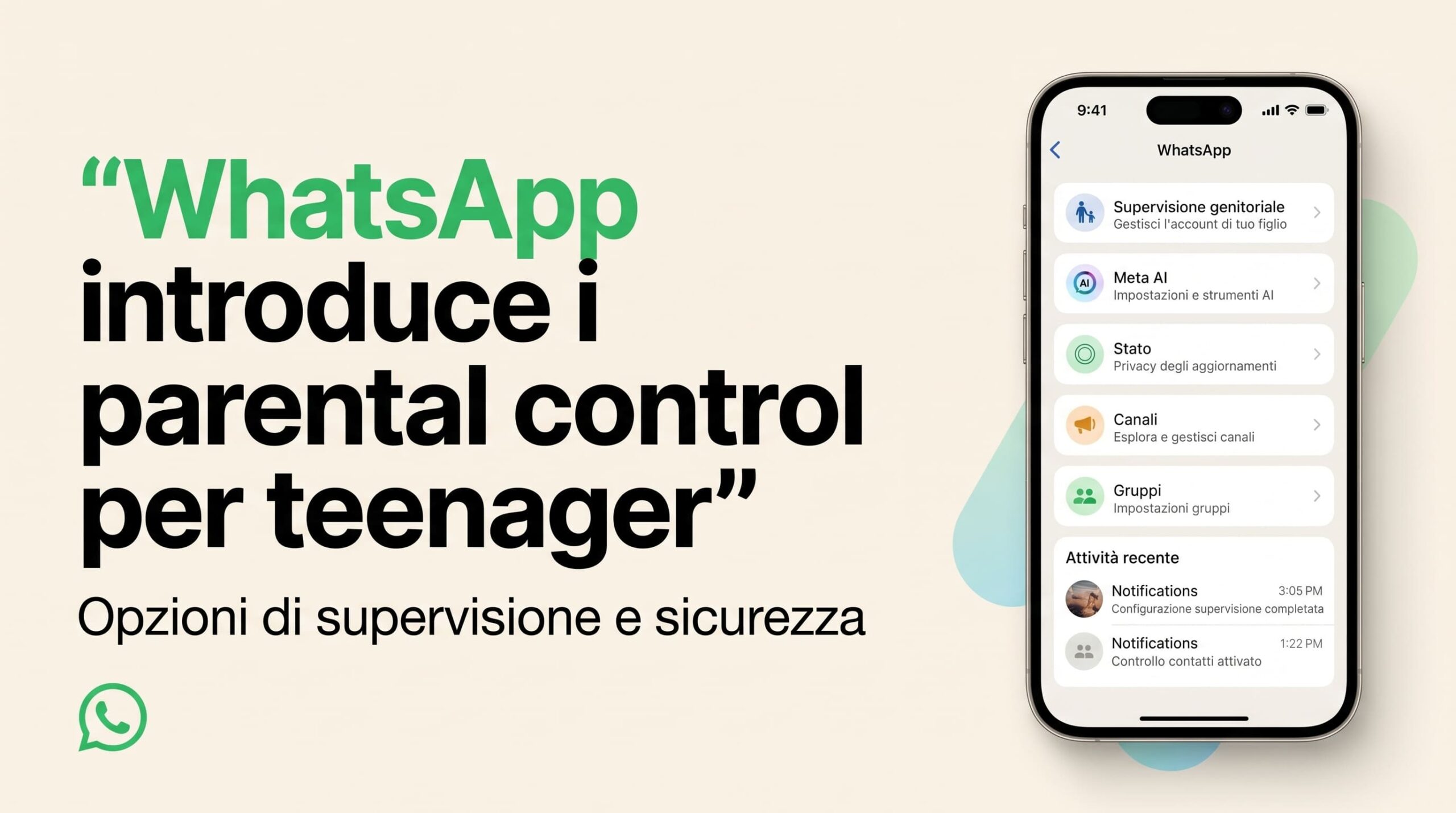
WhatsApp introduces parental controls for teens: what parents will be able to control
WhatsApp introduces new parental control tools for teen accounts. Parents will be able to adjust privacy, groups, status, channels, and the use of Meta AI, but will not have access to the content of private conversations.
WhatsApp extends parental controls to teenagers' accounts.
The news, announced on September 30, 2026, introduces a set of optional tools that parents and kids can set up together to set more precise limits on app use.
However, it is not a tool for monitoring conversations.
Messages and calls will continue to be protected from end-to-end encryption, so neither parents nor WhatsApp will be able to read or listen to the content.
How the new WhatsApp parental controls work
To enable controls, the parent or guardian's account must be linked to the teenager's account.
The configuration takes place from the WhatsApp settings and uses a PIN defined by the parent.
Once controls are enabled, some settings cannot be relaxed by the child without parental approval.
WhatsApp's stated goal is to allow families to choose a supervision level suited to your situation without turning parental control into direct access to personal communications.
Parents will be able to manage some privacy settings
One of the first areas concerns account privacy.
Parents will be able to choose settings regarding who can see certain information about their teenager and who can contact them.
Examples officially listed by WhatsApp include:
- who can view the profile picture;
- who can add the teenager to a group;
- some contact settings;
- some options related to account visibility.
If the child wants to change the settings to a less restrictive level, he or she will have to use the PIN set by the parent.
Notifications about groups and account activity arrive
WhatsApp also introduces a notification system relating to certain activities.
Parents may be informed, for example, when the teenager:
- join a new group;
- create a group;
- leave a group;
- add a new contact;
- join a group that significantly increases in size.
These notifications therefore show some events related to the use of the app, but not the content of the conversations.
This is an important distinction.
Parental control is about How WhatsApp is used, not what is written inside the chats.
Parents will also be able to intervene on Status and Channels
Another new feature concerns two functions that are now central to the WhatsApp experience: Status and Channels.
For Status, the parent can establish:
- what updates the teenager can see;
- who can view the statuses posted by the boy.
The options allow you to limit visibility to contacts, exclude certain contacts, or prevent viewing altogether.
For the Channels, however, it will be possible to choose whether the teenager can:
- follow any channel;
- only follow parent-approved channels;
- do not use the Channels.
The parent can also decide whether or not to allow the creation of new Channels.
Meta AI also joins WhatsApp's parental controls
The most interesting part is probably Meta AI.
WhatsApp lets parents choose between two levels of use of the assistant:
- Standard, based on settings intended for users aged 13 and over;
- Limited, which places additional restrictions on the topics the teenager can interact with Meta AI about.
The most restrictive option therefore further limits the content available through the Assistant.
According to the official documentation, some Meta AI features based on Private Processing are not available when this mode is selected.
The integration of parental controls directly into the AI assistant shows how child safety is becoming an increasingly important issue also in new conversational interfaces.
Parents will not be able to read chats
This is probably the most important point of the news.
Enabling parental controls does not allow the parent to:
- read messages;
- listen to calls;
- view the content of conversations.
WhatsApp confirms that personal messages and calls remain protected from end-to-end encryption.
No one outside the conversation, including WhatsApp and the parent logged into the account, can directly access the content.
The model chosen by WhatsApp therefore tries to maintain a balance between supervision and privacy.
Checks are optional
The new tools are not automatically applied to all teen accounts.
WhatsApp defines them optional.
The parent can choose the level of supervision, change it later, or deactivate it.
To completely remove the link between accounts, you must unlink the parent's account from the teen's. When this is requested from the teen's phone, parental PIN approval may be required.
The rollout will be gradual
Availability will not be immediately identical in all countries.
WhatsApp specifies in its Help Center that parental controls for teenagers are in the process of being implemented. gradual distribution and may not yet be available in all geographic areas.
For this reason, a user may not immediately find the new entry in the app settings.
WhatsApp recommends keeping the app updated to the latest available version.
What this means for your business
The innovation mainly concerns families and private users, but also highlights a broader trend in the digital sector.
The big platforms are introducing systems where Age, privacy and access to features become an integral part of product design.
For companies that develop platforms, communities, chatbots, or digital services that are accessible to minors, this means paying ever greater attention to:
- default privacy settings;
- access control;
- age management;
- differentiated authorizations;
- supervision tools;
- transparency on the use of artificial intelligence.
Therefore, it is not enough to add parental controls at the end of development.
Protecting younger users is increasingly becoming a structural feature of the digital experience.
DigiFe develops AI solutions for business and digital platforms by integrating features, data, and access levels based on the actual needs of the service and users.