
From sustainability to data: why DPP is already a strategic priority
In recent years, sustainability and digitalization have ceased to be two distinct areas and have become a single competitive axis. Companies are no longer required to simply improve their environmental performance, but to make it measurable, traceable, and verifiable throughout the entire supply chain.
It is in this scenario that the Digital Product Passport (DPP), one of the most significant tools introduced by the European Union to redefine the relationship between products, data and the supply chain.
The digital product passport isn't just a regulatory requirement. It introduces a structural change: each product becomes an evolving information system, capable of collecting and sharing data throughout its entire life cycle.
This passage marks a profound discontinuity.
Value no longer lies only in the product, but in the company's ability to manage and govern the data that represents it over time.
The product as an information system: what the DPP really introduces
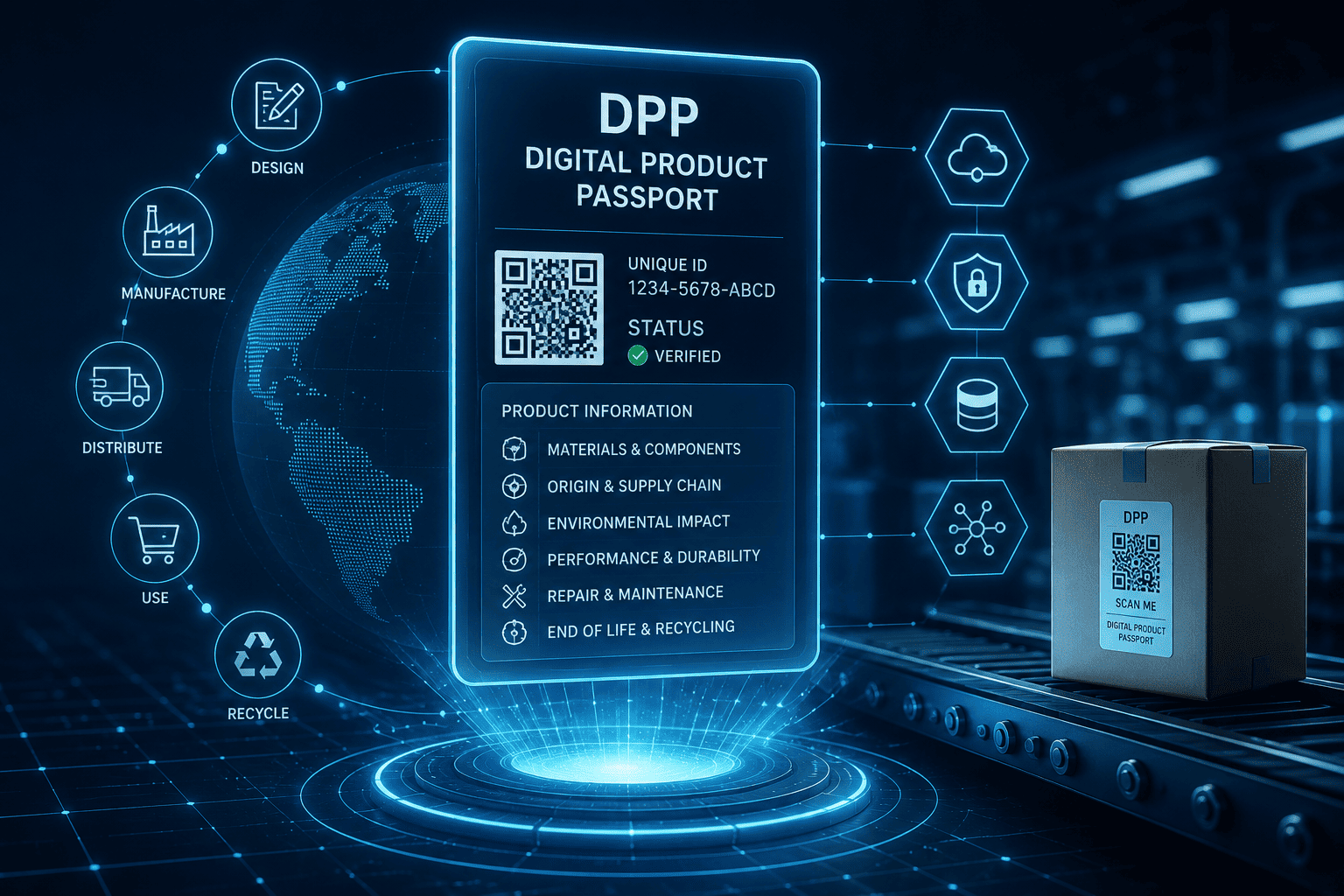
With the Digital Product Passport, each product placed on the European market acquires a unique digital identity, as required by the regulation Ecodesign for Sustainable Products Regulation, an integral part of the European Green Deal and the Circular Economy Action Plan.
This digital identity isn't an accessory. It's structural.
Through a physical connection such as QR code, RFID tag or other technologies, allows access to a set of updatable information that accompanies the product over time.
Unlike traditional systems, DPP doesn't just collect static data. It builds a digital infrastructure capable of:
- connecting design, production and distribution
- make information verifiable along the supply chain
- support maintenance, reuse and recycling processes
- enable new relationship models between producers, partners and customers
The most significant change is conceptual:
the product does not end at the moment of sale, but continues to generate value through the data it produces and updates.
A new regulatory framework: from compliance to data responsibility
The introduction of the DPP marks the transition from a logic of document-based compliance to ongoing responsibility for information management.
Companies that place products on the European market, manufacturers, importers and distributors, are required to ensure that the data associated with the goods are:
- accurate and verifiable
- constantly updated
- accessible according to authorization levels
- structured according to interoperable standards
This implies a significant shift in the way information flows are managed. Data is no longer confined within corporate systems, but becomes a shared resource throughout the supply chain, accessible to various stakeholders: regulatory authorities, industrial partners, logistics operators, repairers, and, in some cases, end users.
A central aspect of the new regulatory framework is the principle of interoperability.
Information must be designed to be exchanged between different systems, overcoming proprietary logic and technological fragmentation.
In this context, compliance with the DPP is not limited to meeting a requirement.
It becomes a matter of organizational capacity and digital maturity.
The heart of DPP: structuring data throughout the lifecycle
The value of the Digital Product Passport lies in the quality and depth of the information it represents. It's not a static archive, but a dynamic system that accompanies the product through all its phases.
The first dimension concerns the composition and origin of materials. Companies must be able to trace the source of raw materials, identify any critical substances, and indicate the percentage of recycled content. This level of transparency is essential to ensure regulatory compliance and supply chain sustainability.
Alongside this, the need to make production processes visible emerges. Plants, production batches, environmental certifications, and impact indicators—such as carbon footprint—become key elements in building a comprehensive and verifiable vision of the product.
A third, increasingly central, area concerns use and end-of-life. The DPP requires integrating information on repairability, spare parts availability, disassembly methods, and the possibilities for recycling or recovering materials. This data is essential for effectively enabling circular economy models.
Taken together, this information transforms the product into a complex digital entity, requiring a structured approach to data management.
Breaking Down Silos: The Impact of DPP on Information Systems
One of the most significant impacts of the Digital Product Passport concerns enterprise systems architecture. In most organizations, product data is distributed across different platforms—ERP, MES, PLM—that are often not fully integrated with each other.
This model is no longer sustainable.
The DPP requires information continuity throughout the product life cycle.
To meet this need, companies must evolve towards integrated architectures, where data can flow seamlessly between design, production, logistics, and after-sales. It's not just about connecting systems, but also about ensuring the consistency and quality of information.
In this scenario, data governance plays a central role. Defining clear rules for data management, updating, and validation becomes essential to ensuring reliability and compliance.
Enabling technologies—cloud, APIs, edge computing, and in some cases, blockchain—are essential tools, but they do not replace the need for structured information system design.
Preparing for the DPP: a path of progressive transformation
Addressing the Digital Product Passport means embarking on a journey that involves processes, technologies, and organization.
The starting point is an assessment of the company's digital maturity. Understanding the level of system integration, the quality of available data, and the ability to manage complex information flows allows you to build a solid foundation for the subsequent phases.
This analysis is followed by mapping information flows along the supply chain. Companies must identify where the data resides, who manages it, and what information is missing or unstructured. It is precisely at this stage that the main critical issues often emerge, especially in relationships with suppliers and upstream partners.
Based on this evidence, it is possible to conduct a gap analysis against the DPP requirements and build a coherent technology roadmap. This involves making enterprise systems interoperable, ensuring API integration, and structuring data according to shared standards.
At the same time, it is necessary to introduce a data governance model that defines responsibilities, update processes, and quality criteria.
Before rolling out the model across the entire organization, pilot testing allows approaches and solutions to be validated in controlled settings, reducing risk and complexity.
The DPP is not a one-off intervention.
It is an evolutionary process that requires vision and method.
Beyond Compliance: DPP as a Lever for Innovation
Simply meeting regulatory requirements means capturing only part of the value of the Digital Product Passport.
Companies that adopt a strategic approach can transform DPP into an innovation tool. Structured product data management helps improve operational efficiency, strengthen supply chain control, and develop new value-added services.
Furthermore, the availability of reliable and shared information increases transparency towards the market, helping to build trust and competitive differentiation.
In this sense, the DPP represents a turning point:
not a constraint imposed by legislation, but an accelerator of digital transformation.
Start now
The Digital Product Passport isn't a distant change. It's a transformation already underway.
Companies starting today have the advantage of building a structured approach, avoiding urgent and fragmented interventions.
Governing product data means governing the future of your business.
Contact Digife to assess your company's level of readiness and define a concrete path towards compliance and innovation.