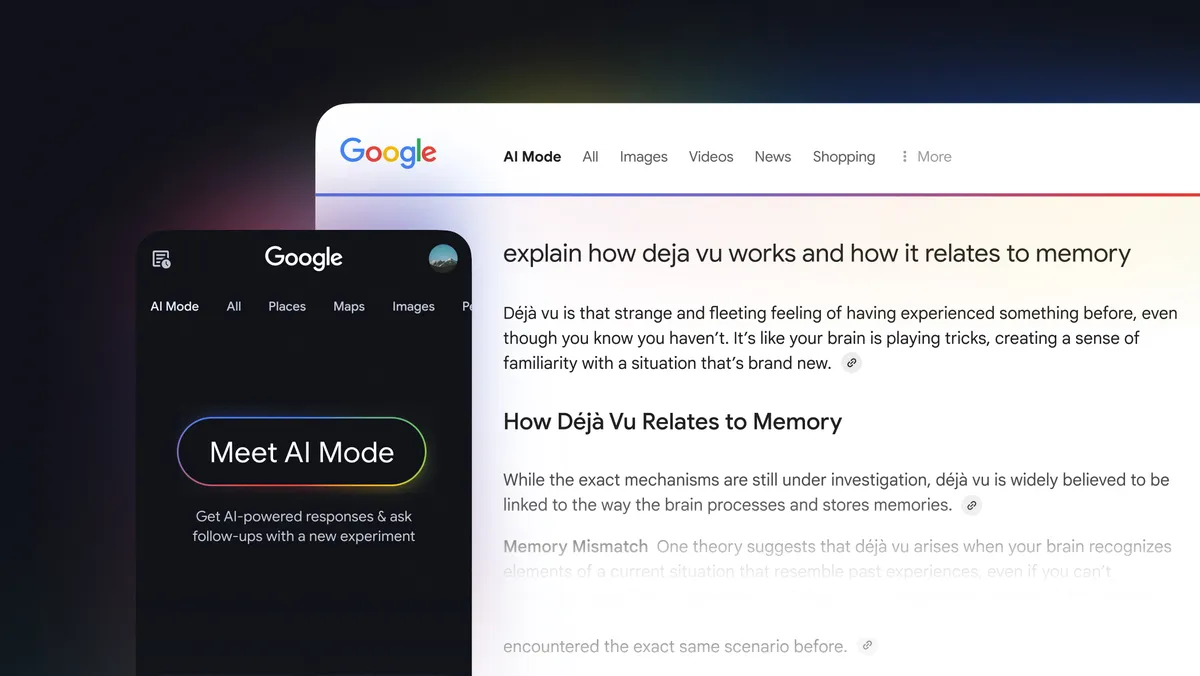
In 2025, the online search experience is changing profoundly. It's no longer just a matter of querying an engine with keywords, but of engaging in a natural dialogue with an artificial intelligence capable of understanding context, intent, and human language. At the heart of this transformation is AI Mode, Google's new conversational mode that redefines the very concept of online visibility.
For companies, developers, content strategists and digital marketing professionals, this change marks a turning point: being visible is no longer enough, you have to become the most useful and complete answer among all those generated by the new intelligence of research.
What really changes with AI Mode
Google defines AI Mode as a mode that allows you to “go beyond information, towards intelligence”. The interaction takes place on a multimodal (text, images, voice) and is structured in a way conversational, prioritizing well-structured, relevant, and semantically coherent responses.
The implications are numerous:
-
Queries are becoming longer, more natural, and tied to real needs.
-
Generic or out-of-date content is penalized.
-
AI responses tend to summarize a single source: therefore, it is necessary to become the most complete and reliable source on the topic.
SEO and content: changing the strategy
Search engine optimization (SEO) is no longer limited to keywords and link building. Today, it is essential to build coherent information ecosystems, with contents that:
-
respond to specific micro-intentions,
-
anticipate natural follow-ups,
-
include visuals, snippets, FAQs, concrete examples, and case studies.
A product sheet or one landing page, for example, must not only list features, but also answer the visitor's implicit question. "What is the best product X for someone looking for Y with budget Z?": this is the new form of the query.
How to prepare for AI Mode
Companies and brands that want maintain a strong online presence must address this scenario strategically:
-
Audit of existing content
Check the quality, structure, and information depth of current content. -
Creating intelligent content
Integrate multimedia formats, tree structures, interactive forms, and semantic markup to help AI identify relevant content. -
Technical review of the website
Speed, accessibility, responsive design, and semantic structure are becoming essential. A site that isn't technically optimized won't appear in AI responses. -
Continuous monitoring and adaptation
Analyzing the queries that drive traffic, conversions, and engagement allows you to constantly evolve your strategy.
Benefits of an AI-Driven Approach
Adopting an AI Mode-oriented strategy is not just a technical response to algorithm evolution, but a competitive choice that offers concrete advantages:
-
Increased organic visibility in the new spaces of conversational research.
-
Increased relevance of incoming traffic, with qualified and interested users.
-
Better user experience, thanks to clearer, more personalized and structured content.
This mode also offers the opportunity to optimize advertisingAds that integrate with AI responses, such as through contextual extensions or landing pages that perfectly match search intent, significantly increase their effectiveness.
A new era for digital marketing
We are facing a paradigm shift. The era of search intent evolves into that of the response intent, where what matters is not just "appearing" but be selected as the ideal answer from an increasingly refined intelligence.
For businesses, digital teams and those who design content, websites and SEO strategies, the time has come to look beyond the SERP and build digital ecosystems designed for intelligent interaction.
AI Mode represents the beginning of a new generation of search: more natural, more precise, more useful. Those who can adapt, structure effective content, and technically optimize their digital presence will be able to transform this change into a concrete growth opportunity.
On digife.it We are ready to lead this transformation: we analyze data, optimize strategy, and build digital projects designed for the future. Because the future is no longer just "being online." It's be relevant in the new era of intelligence applied to research.